If you've ever needed to calculate fuel load for a truck, plan a generator runtime, or understand why diesel and gasoline pumps are labeled differently, you've likely wondered: how much does diesel fuel weigh per gallon? The answer matters for truckers calculating axle weights, fleet managers estimating fuel costs, farmers running irrigation pumps, and anyone who needs to transport or store diesel fuel safely.
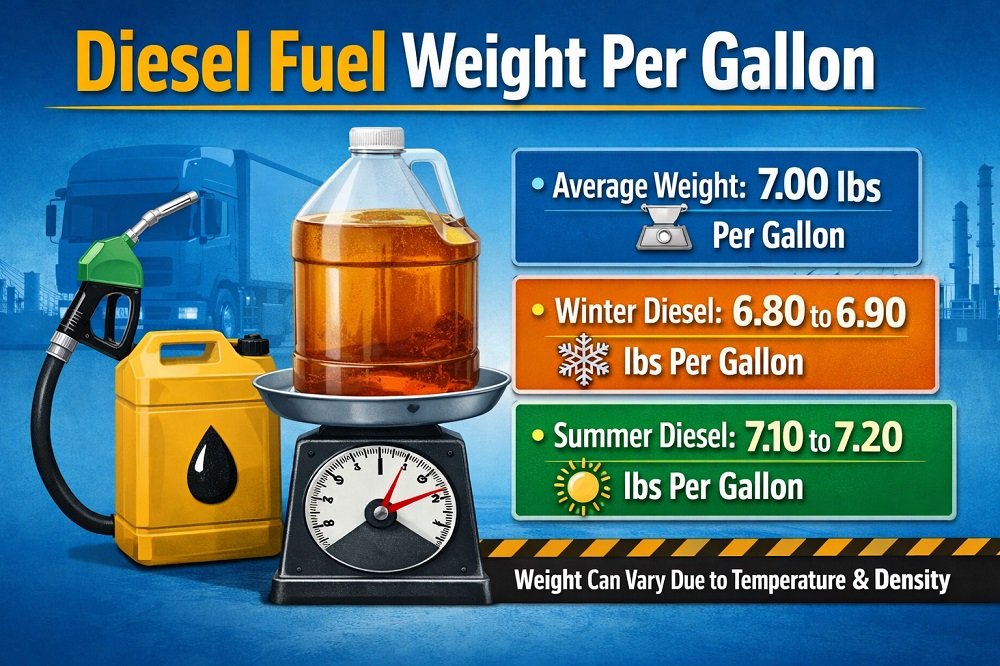
The short answer: diesel fuel weighs approximately 6.943 pounds per US gallon at the standard temperature of 59°F (15°C). But fuel weight isn't always that simple it shifts with temperature, fuel grade, and even the season. This complete guide covers everything you need to know about diesel fuel weight per gallon.
🔑 Key Takeaways
- Diesel weighs ~6.943 lbs per US gallon at 59°F (15°C) the industry-standard reference temperature
- In metric units, diesel fuel density is approximately 0.832 kg/L (832 kg/m³)
- Diesel is approximately 14% heavier than gasoline, which weighs ~6.073 lbs/gal
- Temperature directly impacts diesel weight colder = heavier per gallon, warmer = lighter per gallon
- 150 gallons of diesel weighs approximately 1,041 lbs (472 kg)
- A full semi-truck (300 gallon tanks) carries roughly 2,083 lbs (945 kg) of diesel alone
- Biodiesel blends (B20, B100) are slightly heavier than standard diesel
📋 Table of Contents
- Diesel Fuel Weight Per Gallon The Exact Number
- What Affects Diesel Fuel Weight?
- Diesel vs Gasoline Weight Comparison
- Diesel Weight by Volume: Quick Reference Table
- Temperature vs Diesel Weight Table
- Different Diesel Grades and Their Weights
- Real-World Diesel Weight Calculations
- Trucking, Agriculture & Generator Applications
- Pro Tips for Fuel Weight Planning
- Frequently Asked Questions
Diesel Fuel Weight Per Gallon The Exact Number
The weight of diesel fuel per US gallon is officially defined as 6.943 pounds (lbs) at 59°F (15°C). This is the temperature used by the petroleum industry as the international standard reference point (also called the base temperature for density measurements).
• 1 US gallon of diesel = 6.943 lbs (3.149 kg)
• 1 liter of diesel = 0.832 kg (1.834 lbs)
• 1 imperial gallon of diesel = 8.334 lbs (3.780 kg)
• Density at 15°C: 0.820–0.845 g/mL (typical range)
• API Gravity: 30–45° API
Diesel's density gives it a specific gravity (SG) of approximately 0.820 to 0.845 relative to water at the same temperature. Since water weighs exactly 8.34 lbs per US gallon, diesel's SG of ~0.832 means it's about 83.2% as dense as water which also explains why diesel floats on water (it's lighter).
What Affects Diesel Fuel Weight?
Diesel fuel is not a single uniform compound it's a complex mixture of hydrocarbons with varying molecular weights. Several factors influence exactly how much a gallon of diesel weighs:
1. Temperature
This is the biggest variable. Like all liquids, diesel expands when heated and contracts when cooled. A gallon of cold diesel (in winter) contains more actual fuel molecules than a gallon measured in summer heat. This is why:
- Airlines, trucking companies, and fuel distributors often measure fuel by weight or corrected volume, not raw gallons
- Buying fuel in the cool morning can give you slightly more energy per gallon than midday purchases
- A change of 15°F causes approximately a 1% change in diesel volume
2. Diesel Grade / Type
Different diesel grades have slightly different densities:
- No. 1-D (Winter Diesel): Lighter, less dense approximately 6.70–6.85 lbs/gal. Better cold-weather performance but slightly less energy per gallon.
- No. 2-D (Standard Diesel / ULSD): Most common grade approximately 6.85–7.00 lbs/gal. Higher energy content than No. 1-D.
- No. 4-D (Heavy Fuel Oil): Used in large marine and industrial engines heavier, approximately 7.05–7.20 lbs/gal.
3. Biodiesel Content
Biodiesel (made from vegetable oils or animal fats) is slightly denser than petroleum diesel. Common blends:
- B5 (5% biodiesel): ~6.95 lbs/gal
- B20 (20% biodiesel): ~7.00–7.05 lbs/gal
- B100 (pure biodiesel): ~7.35 lbs/gal
4. Sulfur Content
Ultra-Low Sulfur Diesel (ULSD), required in the US since 2006, has a sulfur content of ≤15 ppm. The removal of sulfur slightly reduces density compared to older high-sulfur diesel, though the difference is minimal in practice.
Diesel vs Gasoline Weight Comparison
One of the most common questions is how diesel compares to gasoline in terms of weight. Here's a direct side-by-side comparison:
| Property | Diesel Fuel | Regular Gasoline |
|---|---|---|
| Weight per US gallon | 6.943 lbs | 6.073 lbs |
| Weight per liter | 0.832 kg | 0.720–0.740 kg |
| Specific gravity at 15°C | 0.820–0.845 | 0.720–0.775 |
| Energy content (BTU/gal) | ~138,700 BTU | ~114,000–125,000 BTU |
| Boiling point range | 302–572°F (150–300°C) | 95–395°F (35–200°C) |
| Floats on water? | Yes | Yes |
Diesel is approximately 14% heavier than gasoline by the same volume. This density difference is one reason diesel engines are more fuel-efficient more energy is packed into each gallon, and the higher compression ratios in diesel engines extract more of that energy.
Diesel Weight by Volume: Quick Reference Table
Use this table to quickly calculate the weight of diesel fuel for any volume. All values are at the standard temperature of 59°F (15°C) using 6.943 lbs/US gallon.
| Volume (US Gallons) | Weight (lbs) | Weight (kg) | Common Use |
|---|---|---|---|
| 1 gallon | 6.943 lbs | 3.15 kg | Small equipment, references |
| 5 gallons | 34.7 lbs | 15.7 kg | Portable fuel can |
| 10 gallons | 69.4 lbs | 31.5 kg | Small tractor tank fill |
| 20 gallons | 138.9 lbs | 63.0 kg | Pickup truck diesel tank |
| 50 gallons | 347.2 lbs | 157.5 kg | Generator, small farm equipment |
| 100 gallons | 694.3 lbs | 314.9 kg | One semi-truck tank |
| 150 gallons | 1,041.5 lbs | 472.4 kg | Fuel reserve tank / planning |
| 200 gallons | 1,388.6 lbs | 630.1 kg | Large truck dual-tank system |
| 300 gallons | 2,082.9 lbs | 945.1 kg | Full semi-truck dual-tank load |
| 500 gallons | 3,471.5 lbs | 1,575.2 kg | Farm bulk tank |
| 1,000 gallons | 6,943 lbs | 3,150.4 kg | Storage tank / refueling depot |
Weight (lbs) = Volume (US gallons) × 6.943
Weight (kg) = Volume (liters) × 0.832
Example: How much does 150 gallons of diesel weigh?
150 × 6.943 = 1,041.45 lbs (≈ 472 kg)
Temperature vs Diesel Weight Table
Since diesel density changes with temperature, here's how the weight of diesel per gallon varies across the temperature range you're likely to encounter:
| Temperature | Weight (lbs/US gal) | Density (kg/L) | Notes |
|---|---|---|---|
| 14°F (-10°C) | ~7.10 lbs/gal | ~0.851 kg/L | Cold winter conditions |
| 32°F (0°C) | ~7.05 lbs/gal | ~0.845 kg/L | Freezing point of water |
| 59°F (15°C) | 6.943 lbs/gal | 0.832 kg/L | Standard reference temperature |
| 68°F (20°C) | ~6.90 lbs/gal | ~0.827 kg/L | Comfortable room temperature |
| 86°F (30°C) | ~6.82 lbs/gal | ~0.818 kg/L | Warm summer day |
| 104°F (40°C) | ~6.75 lbs/gal | ~0.809 kg/L | Hot climate or direct sun exposure |
Different Diesel Grades and Their Weights
In North America and globally, diesel fuel is categorized by grade. Each grade has a different hydrocarbon composition, which affects both weight and energy content:
| Diesel Grade | Weight (lbs/US gal) | Best Used For | Notes |
|---|---|---|---|
| No. 1-D (1-D ULSD) | 6.70–6.85 lbs/gal | Cold climates, winter operation | Lower density, won't gel in cold |
| No. 2-D (2-D ULSD) | 6.85–7.00 lbs/gal | Standard trucking, agriculture, power gen | Most common; EPA mandated since 2006 |
| No. 4-D | 7.05–7.25 lbs/gal | Large marine engines, industrial boilers | Not usable in most road vehicles |
| B5 Blend | ~6.95 lbs/gal | General use (5% biodiesel) | Common in many US states |
| B20 Blend | ~7.00–7.05 lbs/gal | Fleets, agriculture (20% biodiesel) | Good performance, lower emissions |
| B100 (Pure Biodiesel) | ~7.35 lbs/gal | Specialized equipment | Requires engine modifications |
Real-World Diesel Weight Calculations
Example 1: How Much Does 150 Gallons of Diesel Weigh?
This is one of the top searched questions around diesel weight. Here's the step-by-step calculation:
- Standard diesel weight: 6.943 lbs per US gallon
- Volume: 150 gallons
- Calculation: 150 × 6.943 = 1,041.45 lbs
- In kilograms: 1,041.45 ÷ 2.205 = 472.4 kg
This is roughly the weight of a small car, which is significant when calculating trailer payload capacity.
Example 2: Full Semi-Truck Fuel Load
A typical long-haul semi-truck carries two 150-gallon tanks (300 gallons total):
- 300 gallons × 6.943 lbs/gal = 2,082.9 lbs
- In metric: 300 × 3.785 L/gal × 0.832 kg/L = 944.6 kg
This means a fully fueled semi carries nearly a ton of diesel before loading any cargo a critical consideration for DOT weight regulations (80,000 lb GVW limit in the US).
Example 3: Generator Runtime Fuel Planning
A 100 kW diesel generator consumes approximately 7.2 gallons per hour at full load. For a 24-hour emergency operation:
- Fuel needed: 7.2 × 24 = 172.8 gallons
- Weight: 172.8 × 6.943 = 1,199.4 lbs (544 kg)
Knowing this helps engineers design proper fuel storage pads, structural supports, and emergency fuel delivery logistics.
Example 4: Diesel Pickup Truck Tank
A Ford F-250 Power Stroke diesel has a 26-gallon fuel tank:
- 26 × 6.943 = 180.5 lbs of diesel when full
- Compared to an empty tank, this adds about 181 lbs of weight
This matters for payload calculations, especially when towing near maximum rated capacity.
Trucking, Agriculture & Generator Applications
Understanding diesel fuel weight per gallon is essential in several professional contexts:
Trucking & Freight Industry
DOT regulations in the United States limit gross vehicle weight to 80,000 lbs on interstate highways. Fuel weight is part of that calculation:
- Drivers must account for fuel weight when calculating available payload
- Full fuel tanks (300 gal) add over 2,000 lbs to the truck's weight
- Fuel weight affects axle weight distribution and bridge formula compliance
- Fuel is often purchased by weight (reefer units, aviation fuel) rather than volume for accuracy
Agriculture & Farm Equipment
Farmers and agriculture businesses rely heavily on diesel for tractors, combines, irrigation pumps, and drying equipment. Key considerations:
- Bulk storage tanks (500–10,000+ gallons) require structural support rated for the fuel weight
- Portable fuel trailers must comply with DOT weight limits
- Tractor fuel consumption (1–4 gal/hr) and tank sizes (50–200 gal) inform daily fuel weight loads
Backup Generators & Data Centers
Critical facilities use diesel generators for backup power. Weight considerations include:
- Day tanks near the generator (50–250 gallons) must have proper pad weight ratings
- Above-ground storage tanks (AST) for large facilities hold 1,000–50,000+ gallons weight load on the structure is critical
- Fire codes often limit fuel quantities in certain areas based on weight and volume
Pro Tips for Diesel Fuel Weight Planning
If you're doing precise fuel accounting (billing, military, aviation), always correct diesel volume to the standard 60°F (15.6°C). Most modern fuel management systems do this automatically, but manual calculations should apply the thermal expansion factor: ±0.00063 per °F from 60°F.
For trucking payload, structural loads, and fuel energy calculations, always work in weight (lbs or kg) rather than gallons. Volume measurements are subject to temperature variation, while weight is a fixed physical property. Use our weight converter to convert between lbs and kg instantly.
In cold climates, stations switch from No. 2-D to No. 1-D diesel in winter to prevent gelling. No. 1-D has a lower density, so a winter gallon of diesel may only weigh 6.70–6.80 lbs vs the summer 2-D's 6.943 lbs. This also means slightly less energy per gallon expect 1–3% lower fuel economy in winter.
Before departing, use the formula: Available Payload = GVW Limit − Tare Weight − Fuel Weight. With 300 gallons at 6.943 lbs/gal, deduct 2,083 lbs from your available payload. Pair this with our weight converter for fast lbs/kg conversions at the scale house.
If your fleet uses B20 or higher biodiesel blends, remember that biodiesel is denser. B20 weighs approximately 7.00–7.05 lbs/gal vs 6.943 for standard diesel. Over a 300-gallon fill, that's an extra 15–30 lbs small individually, but it matters for precision weight compliance on already loaded trucks.
Frequently Asked Questions
Conclusion
Diesel fuel weighs 6.943 lbs per US gallon (0.832 kg/L) at the industry standard of 59°F (15°C). This figure is the backbone of fuel load calculations across trucking, agriculture, aviation, marine, and industrial sectors worldwide. Understanding how temperature, diesel grade, and biodiesel blending affect that weight gives you the accuracy needed for safety, compliance, and efficiency.
Whether you're answering "how much does 150 gallons of diesel weigh?" for a fuel delivery or calculating semi-truck payload compliance, use the formula: Weight (lbs) = Gallons × 6.943. For volume-to-weight conversions in other units, our free weight converter and volume converter tools make the math instant and accurate.