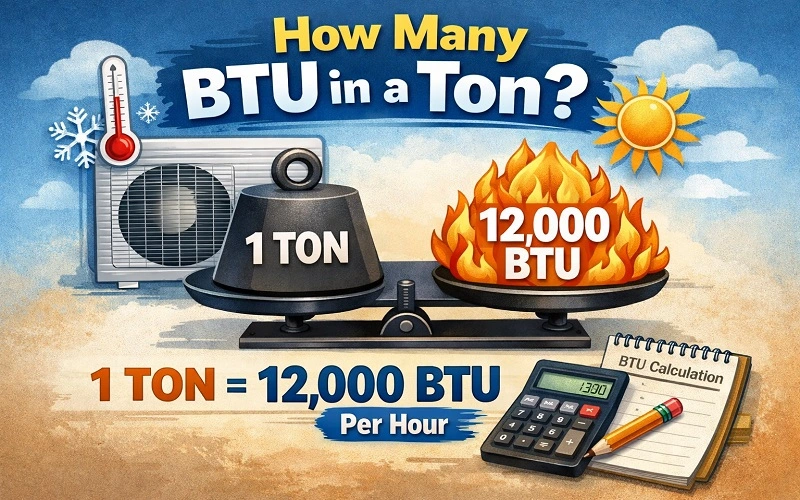
When shopping for an air conditioner or working with HVAC systems, you'll frequently encounter capacity measured in both "tons" and "BTU." Understanding how many BTU are in a ton is essential for choosing the right-sized cooling system for your home or business. This comprehensive guide explains the relationship between tons and BTU, provides conversion formulas, and helps you understand HVAC sizing.
🔑 Key Takeaways
- One ton of cooling equals 12,000 BTU per hour – this is the industry standard conversion
- A 2-ton AC unit produces 24,000 BTU/hr, a 3-ton produces 36,000 BTU/hr
- The term "ton" comes from the cooling equivalent of melting one ton of ice in 24 hours
- BTU (British Thermal Unit) measures energy, while tons measure cooling capacity
- Properly sizing your AC unit based on BTU/tonnage is crucial for efficiency and comfort
📋 Table of Contents
What is BTU?
BTU stands for British Thermal Unit, a measurement of energy. Specifically, one BTU represents the amount of energy required to raise the temperature of one pound of water by one degree Fahrenheit at sea level.
In the context of air conditioning and refrigeration, BTU measures cooling capacity – the amount of heat an AC unit can remove from a space per hour. When you see "12,000 BTU" on an air conditioner specification, it means the unit can remove 12,000 British Thermal Units of heat per hour.
What is a Ton of Refrigeration?
A ton of refrigeration (or "ton of cooling") is a unit of power used to describe the heat-extraction capacity of air conditioning and refrigeration equipment. One ton equals the cooling power needed to melt one ton (2,000 pounds) of ice in 24 hours.
Historical Origin
The term originated in the ice trade of the 1800s when ice was harvested from frozen lakes and used for refrigeration. Engineers calculated that melting one ton of ice over 24 hours requires removing approximately 288,000 BTU of heat. Dividing this by 24 hours gives us 12,000 BTU per hour – the modern standard for one ton of cooling.
Although we no longer use ice for refrigeration, the measurement stuck and remains the industry standard for rating HVAC equipment capacity throughout North America and many other countries.
BTU to Ton Conversion Formula
The conversion between tons and BTU is straightforward and uses a constant multiplier:
1 Ton = 12,000 BTU per hour
To convert tons to BTU:
BTU/hr = Tons × 12,000
To convert BTU to tons:
Tons = BTU/hr ÷ 12,000
Example Calculations
Example 1: Converting 3 tons to BTU
- Formula: BTU/hr = Tons × 12,000
- Calculation: 3 × 12,000 = 36,000 BTU/hr
- Result: 3 tons = 36,000 BTU per hour
Example 2: Converting 48,000 BTU to tons
- Formula: Tons = BTU/hr ÷ 12,000
- Calculation: 48,000 ÷ 12,000 = 4
- Result: 48,000 BTU/hr = 4 tons
Quick Conversion Table: Tons to BTU
Use this reference table for instant conversions between tons and BTU for common AC unit sizes:
| Tons of Cooling | BTU per Hour | Typical Application |
|---|---|---|
| 1 ton | 12,000 BTU/hr | Small room, bedroom |
| 1.5 tons | 18,000 BTU/hr | Large bedroom, small apartment |
| 2 tons | 24,000 BTU/hr | Medium apartment, small house |
| 2.5 tons | 30,000 BTU/hr | 1,200-1,500 sq ft home |
| 3 tons | 36,000 BTU/hr | 1,500-1,800 sq ft home |
| 3.5 tons | 42,000 BTU/hr | 1,800-2,100 sq ft home |
| 4 tons | 48,000 BTU/hr | 2,000-2,400 sq ft home |
| 5 tons | 60,000 BTU/hr | 2,500-3,000 sq ft home |
Common AC Unit Sizes Explained
How Many BTU in a 2 Ton AC Unit?
A 2-ton air conditioner has a cooling capacity of 24,000 BTU per hour. This size is ideal for cooling spaces between 900 and 1,200 square feet, such as medium-sized apartments, small homes, or office spaces. Two-ton units are among the most popular residential AC sizes.
How Many BTU in a 3 Ton AC?
A 3-ton AC unit produces 36,000 BTU per hour of cooling capacity. This is the most common size for average American homes ranging from 1,500 to 1,800 square feet. Three-ton units provide sufficient cooling for most suburban ranch-style homes and townhouses.
How Many BTU in a 4 Ton AC?
A 4-ton air conditioner delivers 48,000 BTU per hour. This larger capacity is suitable for homes between 2,000 and 2,400 square feet, including two-story homes, larger ranch homes, and homes in particularly hot climates where extra cooling power is needed.
How Many BTU in a 5 Ton Air Conditioner?
A 5-ton AC unit provides 60,000 BTU per hour of cooling. These powerful systems are designed for large homes (2,500-3,000+ square feet), commercial spaces, or homes with high ceilings, large windows, or significant heat loads from equipment or sunlight exposure.
How to Calculate Your Cooling Needs
Determining the right AC size for your space involves more than just square footage. Here are the key factors HVAC professionals consider:
Basic Square Footage Method
As a rough estimate, you need approximately 20 BTU per square foot for residential cooling. This provides a baseline calculation:
Required BTU = Square Footage × 20
Required Tons = (Square Footage × 20) ÷ 12,000
Example: For a 1,800 sq ft home:
BTU needed = 1,800 × 20 = 36,000 BTU
Tons needed = 36,000 ÷ 12,000 = 3 tons
Factors That Affect Cooling Requirements
- Climate zone: Hot, humid climates require more cooling capacity
- Insulation quality: Poor insulation increases cooling needs by 10-30%
- Window quantity and quality: Large or single-pane windows add to heat gain
- Ceiling height: Vaulted or high ceilings require additional capacity
- Sun exposure: South and west-facing homes need more cooling
- Occupancy: More people generate more heat
- Appliances and electronics: Heat-generating equipment increases load
- Ductwork condition: Leaky ducts can reduce efficiency by 20-40%
Professional HVAC Tips
Don't rely solely on rules of thumb. HVAC professionals use Manual J load calculations that account for dozens of variables to determine the optimal system size. This detailed analysis ensures maximum efficiency and comfort.
While tonnage determines cooling capacity, the SEER (Seasonal Energy Efficiency Ratio) rating determines how efficiently that cooling is delivered. A higher SEER rating means lower operating costs. Modern units range from SEER 13 to SEER 25+, with higher numbers being more efficient.
When replacing components of a split AC system, ensure the indoor air handler and outdoor condensing unit are properly matched in tonnage. Mismatched components reduce efficiency and lifespan.
If you're planning home additions, removing shade trees, or making other changes that affect heat load, factor these into your AC sizing decision. It's easier to size correctly now than to replace an undersized unit later.
Understanding Ton of Refrigeration vs Ton of Cooling
You may encounter both terms "ton of refrigeration" and "ton of cooling" in HVAC literature. These mean exactly the same thing – both refer to 12,000 BTU per hour of heat removal capacity. The term "refrigeration ton" is more common in commercial and industrial applications, while "cooling ton" is frequently used in residential contexts, but they're interchangeable.
Converting Between Metric and Imperial Units
While BTU and tons are standard in the United States, many countries use metric measurements for cooling capacity. Here are some helpful conversions:
- 1 ton = 3.517 kilowatts (kW)
- 1 ton = 3,024 kilocalories per hour (kcal/hr)
- 1 BTU = 1,055 joules
- 12,000 BTU/hr = 3,517 watts
If you need to convert between these units, use our power converter for accurate calculations between watts, BTU, and other energy measurements.
The Cost Implications of AC Sizing
Understanding the BTU-to-ton relationship has direct financial implications:
- Purchase cost: Larger-tonnage units cost more upfront (typically $200-500 more per additional ton)
- Operating costs: Oversized units cycle frequently, reducing efficiency and increasing bills
- Maintenance costs: Frequent cycling from oversizing increases wear and repair needs
- Humidity control: Properly sized units run longer cycles, providing better dehumidification
Frequently Asked Questions
Conclusion
Understanding how many BTU are in a ton is fundamental to selecting the right air conditioning or refrigeration system. Remember the simple conversion: 1 ton = 12,000 BTU per hour. Whether you're shopping for a 2-ton, 3-ton, 4-ton, or 5-ton AC unit, you can now quickly calculate the BTU rating and understand what it means for your cooling needs.
Proper HVAC sizing is critical for energy efficiency, comfort, and equipment longevity. While the 20 BTU per square foot rule provides a starting point, always consult with qualified HVAC professionals who can perform detailed load calculations specific to your home's characteristics and your local climate.
For more conversion tools and calculators to help with your home improvement projects, explore our comprehensive collection of unit converters including temperature conversion, energy conversion, and power conversion tools.