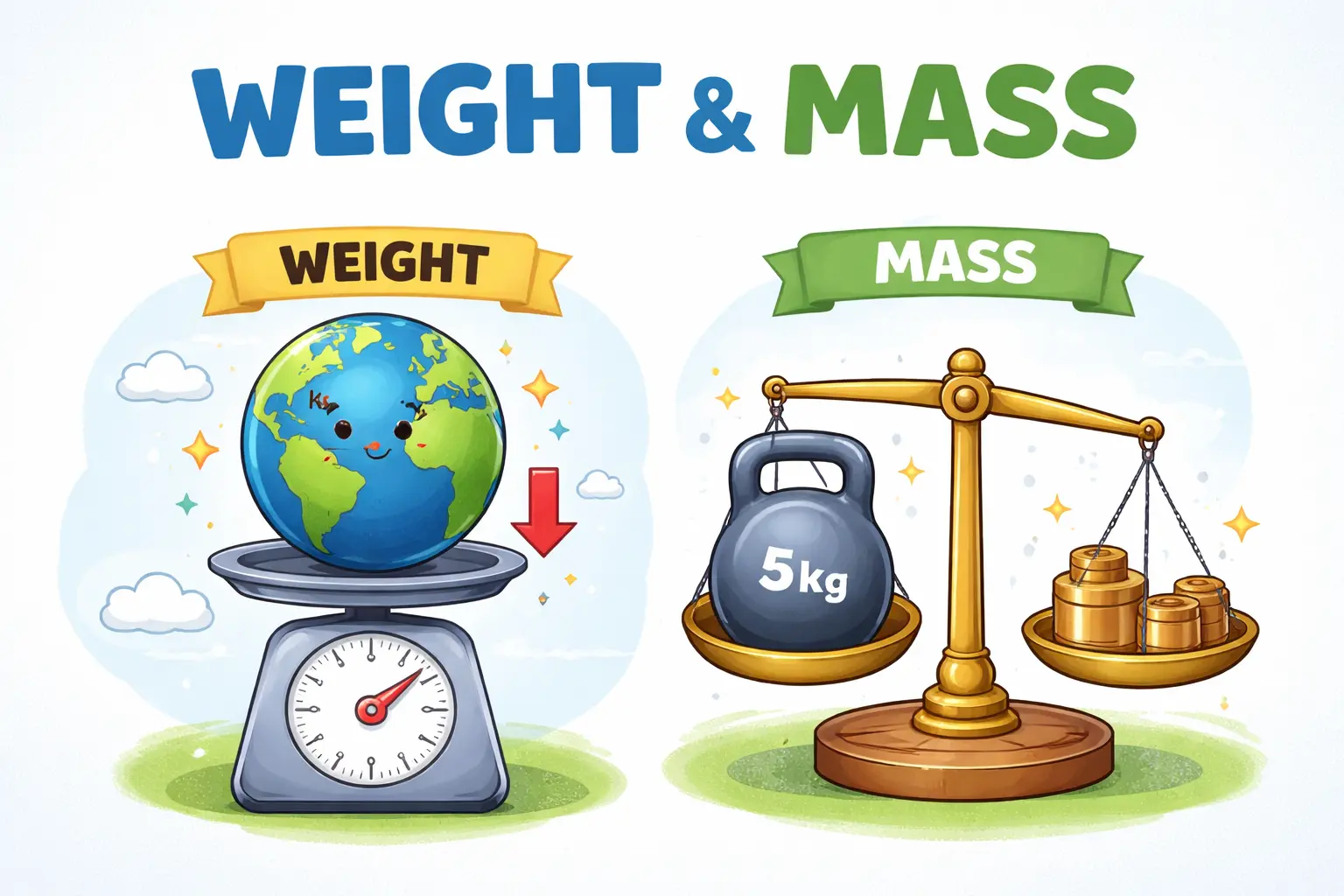
Introduction: A Common Confusion
In everyday conversation, we use "weight" and "mass" interchangeably. We say "I weigh 70 kilograms" or "this box weighs 5 pounds." However, scientifically speaking, weight and mass are fundamentally different physical quantities. Understanding this distinction is crucial for accurate conversions, scientific work, and grasping how the universe works.
This comprehensive guide will clarify the difference between mass and weight, explain when to use each term, and show you how to convert between units correctly. Whether you're a student, scientist, traveler, or just curious, this knowledge will improve your understanding of measurement and physics.
What is Mass?
Mass is a measure of the amount of matter in an object. It's an intrinsic property that doesn't change based on location or circumstance. Whether you're on Earth, the Moon, or floating in deep space, your mass remains constant.
Key Characteristics of Mass
- Scalar Quantity: Mass has magnitude but no direction
- Measure of Inertia: Greater mass means greater resistance to acceleration
- Never Zero: All matter has mass (except massless particles like photons)
- Constant: Doesn't change with location or gravity
- SI Unit: Kilogram (kg)
- Measured by: Balance scales that compare to known masses
Mass Units
- Metric: Kilograms (kg), grams (g), milligrams (mg), metric tons (tonnes)
- Imperial: Pounds mass (lbm), ounces (oz), slugs (technical unit)
- Atomic: Atomic mass units (amu) for molecules and atoms
What is Weight?
Weight is the force exerted on an object due to gravity. It's the gravitational pull between an object's mass and the celestial body it's on (Earth, Moon, Mars, etc.). Weight changes depending on gravitational field strength.
Key Characteristics of Weight
- Vector Quantity: Has both magnitude and direction (always toward the center of mass)
- Gravitational Force: Weight = Mass × Gravitational Acceleration
- Variable: Changes with location and gravitational field
- Can Be Zero: In free fall or zero gravity, weight is zero (but mass remains)
- SI Unit: Newton (N), a unit of force
- Measured by: Spring scales and force gauges
Weight Units
- Scientific: Newtons (N), kilonewtons (kN)
- Everyday (Imperial): Pounds-force (lbf), often just called "pounds"
- Everyday (Metric): Kilogram-force (kgf), though not SI-compliant
On Earth: W = m × 9.80665 (standard gravity)
The Crucial Difference
Here's the fundamental distinction:
- Mass = How much "stuff" an object contains (invariant)
- Weight = How strongly gravity pulls on that "stuff" (variable)
Real-World Example: Astronaut on Different Celestial Bodies
Imagine an astronaut with a mass of 70 kg:
- On Earth: Weight = 70 kg × 9.81 m/s² = 686.7 N (≈ 154 lbs)
- On Moon: Weight = 70 kg × 1.62 m/s² = 113.4 N (≈ 25.5 lbs)
- On Mars: Weight = 70 kg × 3.71 m/s² = 259.7 N (≈ 58.4 lbs)
- In Space: Weight = effectively 0 N (weightless)
The astronaut's mass stays 70 kg everywhere, but their weight changes dramatically.
Weight and Mass Formulas
Calculating Weight from Mass
To find weight from mass on Earth:
Example: 50 kg mass → 50 × 9.81 = 490.5 N weight
Calculating Mass from Weight
Example: 490.5 N weight → 490.5 ÷ 9.81 = 50 kg mass
Proper Conversion Methods
Converting Mass (Proper Conversion)
When converting between mass units, the conversion is straightforward:
- 1 kilogram = 2.20462 pounds (mass)
- 1 pound (mass) = 0.453592 kilograms
- 1 ounce = 28.3495 grams
- 1 metric ton = 1000 kilograms = 2204.62 pounds
Use our weight converter for instant accurate mass conversions!
Converting Weight (Force Units)
- 1 Newton = 0.224809 pounds-force
- 1 pound-force = 4.44822 Newtons
- 1 kilogram-force = 9.80665 Newtons
Practical Implications
Commercial and Trade
When you buy "5 pounds of apples," you're actually buying 5 pounds-mass worth of apples. The scale measures the gravitational force (weight), but calibrates to display mass. This works perfectly fine on Earth where gravity is relatively constant.
Space Exploration
NASA must carefully distinguish mass from weight. A spacecraft might have a mass of 100,000 kg. On Earth, it weighs about 980,665 N, but in orbit it's weightless while retaining all its mass. Rocket scientists must account for this in thrust calculations.
Medical and Fitness
Bathroom scales measure weight (force) but display mass. Medical records track mass (kg or lbs), not weight in Newtons. Your "weight loss" is actually mass loss—you have less matter, not just less gravitational pull.
Engineering
Engineers must distinguish mass (for inertia calculations) from weight (for structural loads). A bridge must support the weight (force) of vehicles, while rocket designers calculate fuel consumption based on mass.
How Scales Work
Spring Scales
Spring scales measure weight (force). They work by measuring how much a spring compresses or stretches under gravitational pull. These would show different readings on the Moon because the gravitational force differs.
Balance Scales
Balance scales compare masses. Two objects balance when their masses are equal, regardless of gravity. A balance scale would work identically on Earth, the Moon, or Mars because it compares mass, not weight.
Digital Scales
Most digital scales measure weight (force on a sensor) but convert to mass using Earth's standard gravity. They display mass (kg or lbs) even though they technically measure weight.
Common Misconceptions
Misconception 1: Weightlessness Means No Mass
False. Astronauts in orbit are weightless because they're in continuous free fall, but they retain all their mass. They're still difficult to push or stop because of inertia.
Misconception 2: Mass and Weight Are the Same on Earth
Technically False. They're different quantities even on Earth—mass is amount of matter, weight is gravitational force. They're just numerically related by Earth's gravity.
Misconception 3: Kilograms Measure Weight
False. Kilograms measure mass. The proper unit for weight is Newtons. Saying "I weigh 70 kg" is colloquially accepted but scientifically imprecise.
Why Different Locations Have Different Gravity
Even on Earth, gravity isn't perfectly uniform:
- Equator: 9.78 m/s² (weaker due to centrifugal force from Earth's rotation)
- Poles: 9.83 m/s² (stronger, no centrifugal effect)
- Standard gravity: 9.80665 m/s² (defined for calculations)
- Altitude effects: Gravity decreases slightly at higher elevations
These differences are tiny for everyday purposes but matter in precision scientific work.
Pro Tips for Understanding Mass vs Weight
Memorize Weight = Mass × Gravity. This single formula connects both concepts and helps you understand when you're dealing with which quantity.
When you see "kg to lbs," remember both are mass units. When you see "Newtons," that's always weight (force). Proper unit usage prevents confusion in scientific and engineering work.
In everyday life, saying "I weigh X pounds" is fine—everyone understands. In scientific work, be precise: "I have a mass of X kg" or "My weight is X Newtons."
For everyday conversions (kg to lbs, pounds to kg), use our weight converter. For force calculations, convert Newtons separately.
Why It Matters for Conversions
Understanding the difference ensures accuracy:
- Scientific Work: Physics calculations require distinguishing force from mass
- International Standards: Proper unit usage prevents errors in documentation
- Engineering Calculations: Structural analysis, aerospace, and mechanics demand precision
- Medical Records: Body mass index properly uses mass, not weight in Newtons
Using Conversion Tools Correctly
When using our conversion tools, remember:
- Converting kg to lbs = converting mass to mass (correct)
- Bathroom scale readings = mass values (though measured via weight)
- If you need actual weight force, multiply mass by gravity
- In everyday contexts, "weight in pounds" really means "mass that weighs that many pounds on Earth"
Conclusion
While "weight" and "mass" are used interchangeably in daily life, understanding their scientific difference is essential for accurate conversions and proper scientific thinking. Mass measures the amount of matter (invariant), while weight measures gravitational force (variable with location).
For everyday purposes on Earth, the distinction rarely causes problems—when you convert 50 kg to 110 lbs, you're converting mass to mass. However, for scientific work, space exploration, and precision engineering, respecting the difference between these quantities is crucial.
Use our conversion tools to accurately convert between mass units, and impress your friends with your newfound understanding of this fundamental physics concept!
• Complete Guide to Unit Conversions 2026
• Metric vs Imperial Systems
• Engineering Unit Conversions
• Use Our Weight Converter