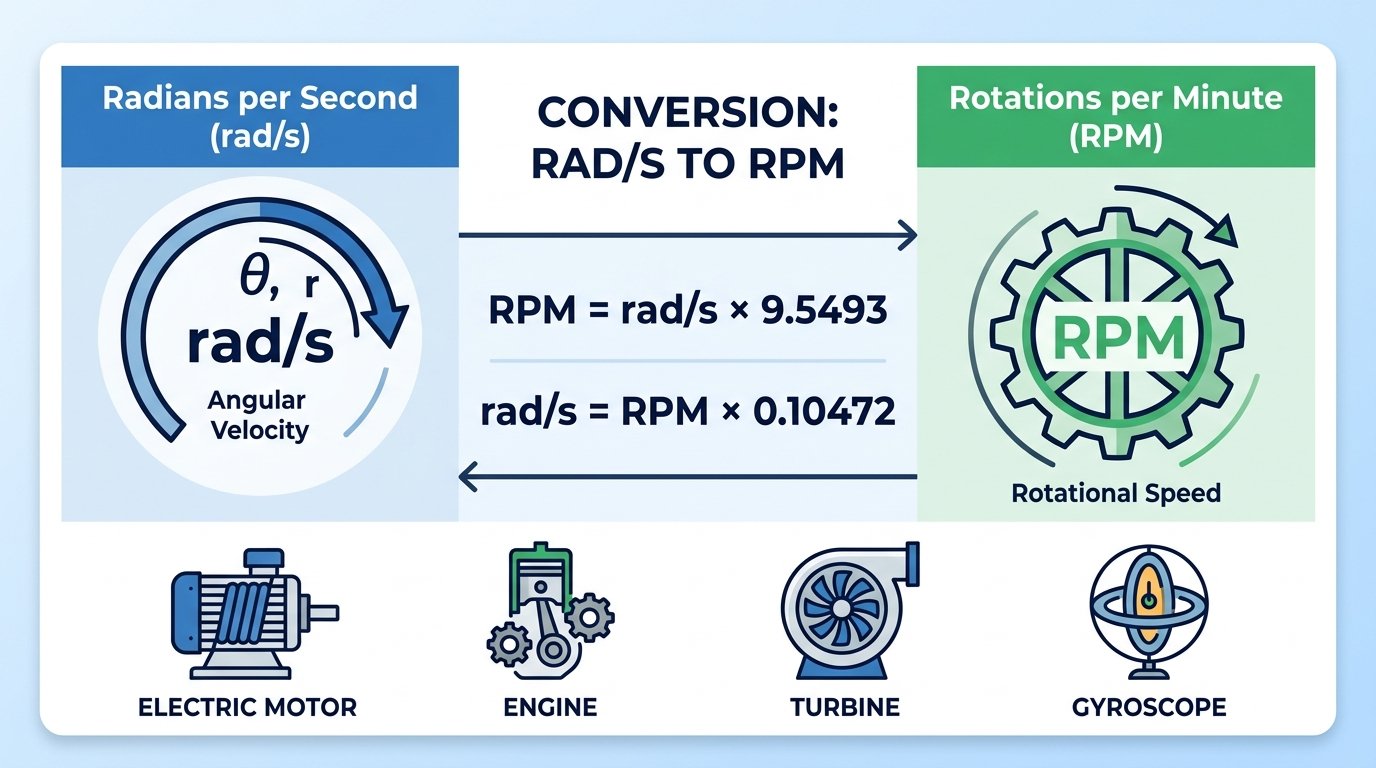
If you work with motors, engines, robotics, or any rotating system, you will regularly encounter two ways of expressing rotational speed: radians per second (rad/s) and revolutions per minute (RPM). Physics and engineering software almost always use rad/s, while motor datasheets, tachometers, and vehicle specifications typically use RPM. Knowing how to convert between the two is an essential skill. This guide explains the radians per second to RPM conversion formula, walks through real examples, and provides a free calculator and reference table.
Formula: RPM = rad/s × (30 / π)
Example: 10 rad/s = 10 × 9.5493 = 95.49 RPM
Reverse: rad/s = RPM × (π / 30) ≈ RPM × 0.10472
🔑 Key Takeaways
- 1 rad/s = 30/π RPM ≈ 9.5493 RPM
- 1 RPM = π/30 rad/s ≈ 0.10472 rad/s
- The conversion factor comes from: 1 revolution = 2π radians, 1 minute = 60 seconds
- rad/s is the SI unit of angular velocity (symbol: ω, omega)
- RPM is a practical unit used in motor specs, engines, and machinery
- Both units measure the same physical quantity: rotational speed
📋 Table of Contents
- What Is Radians Per Second (rad/s)?
- What Is RPM? Revolutions Per Minute Explained
- The rad/s to RPM Conversion Formula Explained
- Free rad/s to RPM Calculator
- Worked Examples: Radians Per Second to RPM
- Radians Per Second to RPM Conversion Table
- Reverse Conversion: RPM to Radians Per Second
- Angular Frequency vs Angular Velocity
- Practical Applications
- Frequently Asked Questions
What Is Radians Per Second (rad/s)?
Radians per second (rad/s) is the SI unit of angular velocity, symbolised by the Greek letter ω (omega). It describes how quickly an object rotates by measuring the angle swept per unit of time. Specifically, it tells you how many radians of arc an object completes every second.
A radian is the angle subtended at the centre of a circle by an arc equal in length to the radius of that circle. Since the circumference of a full circle equals 2π times the radius, one complete revolution sweeps exactly 2π radians (approximately 6.2832 radians). This geometric relationship is the foundation of every radians per second to RPM conversion.
Because rad/s fits naturally into equations from Newton's second law for rotation, power calculations (P = τω), and harmonic motion, it is the preferred unit in physics, control systems, signal processing, and mechanical engineering analysis. Any time you see ω in an equation, the expected unit is rad/s.
What Is RPM? Revolutions Per Minute Explained
RPM stands for revolutions per minute (sometimes written r/min or rev/min). It counts the number of complete 360-degree rotations a shaft, wheel, or rotor makes in one minute. Unlike rad/s, RPM does not require knowledge of radians and is therefore more intuitive for technicians, operators, and everyday use.
RPM appears on motor nameplates, engine tachometers, drill speed settings, hard drive specifications, and centrifuge controls. A car engine idling at 800 RPM completes 800 full rotations of the crankshaft every minute. An electric motor rated at 3,000 RPM spins 3,000 times per minute under no-load conditions.
While RPM is practical and widely understood, it cannot be plugged directly into most physics equations without first converting to rad/s. This is why engineers and scientists regularly need to move between the two representations.
The rad/s to RPM Conversion Formula Explained
The formula follows directly from two definitions: one full revolution equals 2π radians, and one minute equals 60 seconds.
If a shaft rotates at ω rad/s, then in one second it completes ω / (2π) full revolutions. In one minute (60 seconds) it completes 60ω / (2π) revolutions. Simplifying gives the conversion factor:
RPM = ω × (60 / 2π) = ω × (30 / π)
Approximate multiplier: ω × 9.54930
RPM to rad/s Formula (reverse):
ω (rad/s) = RPM × (2π / 60) = RPM × (π / 30)
Approximate multiplier: RPM × 0.104720
Where π = 3.14159265... (pi, the ratio of a circle's circumference to its diameter)
The factor 30/π is exact. It is not an approximation: it comes from the exact definitions of the radian and the minute. When you use 9.5493, you are using a rounded version accurate to 5 significant figures, which is sufficient for virtually all engineering calculations. For precision scientific work, use the full expression 30/π.
⚡ Free rad/s to RPM Calculator
Enter any angular velocity value and select your conversion direction. Results use the exact factor 30/π for rad/s to RPM and π/30 for the reverse:
Angular Velocity Converter
Type a value and choose the conversion direction:
Worked Examples: Radians Per Second to RPM
Each example below applies the formula RPM = rad/s × (30/π) step by step.
Example 1: Convert 1 rad/s to RPM
1 × (30/π) = 30/3.14159 = 9.5493 RPM. This is the fundamental conversion unit. One radian per second is just under 10 RPM.
Example 2: Convert 10 rad/s to RPM
10 × 9.5493 = 95.49 RPM. A small DC motor or a slow-moving conveyor roller might operate in this range.
Example 3: Convert 50 rad/s to RPM
50 × 9.5493 = 477.46 RPM. A typical lathe spindle running at low speed or a large industrial fan might turn at around this rate.
Example 4: Convert 100 rad/s to RPM
100 × 9.5493 = 954.93 RPM. Many AC induction motors have synchronous speeds near this range depending on pole count and supply frequency.
Example 5: Convert 314.16 rad/s to RPM
314.16 × 9.5493 = 3,000 RPM. Note that 314.16 rad/s = 100π rad/s, which is the angular velocity of a 2-pole AC motor on a 50 Hz supply running at synchronous speed. This is one of the most common values encountered in electrical engineering.
Example 6: Convert 628.32 rad/s to RPM
628.32 × 9.5493 = 6,000 RPM. This corresponds to 200π rad/s, typical for high-speed servo motors and some small engine idle speeds.
Radians Per Second to RPM Conversion Table
This reference table covers commonly used angular velocity values. All RPM values are calculated using RPM = rad/s × (30/π), rounded to two decimal places.
| rad/s | RPM | rev/s (Hz) | Degrees/s |
|---|---|---|---|
| 0.1 rad/s | 0.9549 RPM | 0.01592 Hz | 5.73°/s |
| 0.5 rad/s | 4.7746 RPM | 0.07958 Hz | 28.65°/s |
| 1 rad/s | 9.5493 RPM | 0.15915 Hz | 57.30°/s |
| 2 rad/s | 19.0986 RPM | 0.31831 Hz | 114.59°/s |
| 5 rad/s | 47.746 RPM | 0.79577 Hz | 286.48°/s |
| 10 rad/s | 95.493 RPM | 1.5915 Hz | 572.96°/s |
| 20 rad/s | 190.986 RPM | 3.1831 Hz | 1,145.92°/s |
| 50 rad/s | 477.46 RPM | 7.9577 Hz | 2,864.79°/s |
| 100 rad/s | 954.93 RPM | 15.915 Hz | 5,729.58°/s |
| 157.08 rad/s | 1,500 RPM | 25.00 Hz | 9,000°/s |
| 200 rad/s | 1,909.86 RPM | 31.831 Hz | 11,459.16°/s |
| 314.16 rad/s | 3,000 RPM | 50.00 Hz | 18,000°/s |
| 500 rad/s | 4,774.65 RPM | 79.577 Hz | 28,647.89°/s |
| 628.32 rad/s | 6,000 RPM | 100.00 Hz | 36,000°/s |
| 1,000 rad/s | 9,549.30 RPM | 159.155 Hz | 57,295.78°/s |
Reverse Conversion: RPM to Radians Per Second
Going the other direction is equally straightforward. Multiply the RPM value by π/30:
ω (rad/s) = RPM × (π / 30)
Approximate multiplier: RPM × 0.10472
Common examples:
1,000 RPM = 1,000 × 0.10472 = 104.72 rad/s
1,500 RPM = 1,500 × 0.10472 = 157.08 rad/s
3,000 RPM = 3,000 × 0.10472 = 314.16 rad/s
6,000 RPM = 6,000 × 0.10472 = 628.32 rad/s
Notice that 3,000 RPM gives exactly 100π rad/s (314.159...) and 6,000 RPM gives 200π rad/s. These clean multiples of π appear frequently in AC motor calculations because synchronous speeds on 50 Hz and 60 Hz supplies fall at predictable RPM values. For a broader look at how angular and linear units relate to each other, see our guide on engineering unit conversions covering force, power, and rotational quantities.
Angular Frequency vs Angular Velocity
You may see the symbol ω used for two slightly different but closely related concepts: angular velocity and angular frequency. In mechanics, angular velocity describes the rate of rotation of a physical object. In electrical engineering and signal processing, angular frequency describes the rate of oscillation of a sinusoidal signal or AC waveform.
Both are measured in rad/s and use the same symbol ω. The formulas are also the same: ω = 2πf, where f is the frequency in hertz (Hz). For a 50 Hz AC supply, the angular frequency is 2π × 50 = 314.16 rad/s. This is why an AC motor with synchronous speed 3,000 RPM on a 50 Hz supply has an angular velocity that exactly matches the supply's angular frequency — by design.
When converting radians per second to RPM in an electrical context, the value of ω may represent the electrical frequency of the supply rather than the mechanical speed of the shaft. For synchronous machines these are directly linked; for asynchronous (induction) motors, the shaft speed in rad/s will be slightly lower than the supply's angular frequency due to slip.
Practical Applications of the rad/s to RPM Conversion
Understanding radians per second to RPM comes up in more situations than you might expect. Here are the most common engineering and scientific contexts:
Electric Motors and Drives
Motor control software, variable frequency drives (VFDs), and simulation tools like MATLAB and Simulink express motor speed in rad/s because it integrates directly into torque-power equations (P = τω). Motor nameplates and tachometers display RPM. Engineers switch between the two constantly when commissioning or troubleshooting drive systems. A 4-pole induction motor running at 1,450 RPM has an angular velocity of 1,450 × π/30 = 151.84 rad/s.
Internal Combustion Engines
Engine management systems and simulation software use rad/s for crankshaft angular velocity. A petrol engine redlining at 7,000 RPM is spinning at 7,000 × 0.10472 = 733 rad/s. Fuel injection timing, valve timing, and power output calculations all depend on this value expressed in rad/s.
Robotics and Servo Systems
Robot joint velocity is typically specified in rad/s in ROS (Robot Operating System) and other control frameworks. When tuning PID controllers, gains are set based on rad/s values. Servo motor catalogues, however, quote maximum speeds in RPM. The conversion is performed constantly during robot design and commissioning. Our guide on speed unit conversions covers related linear speed concepts.
Aerospace and Gyroscopes
Gyroscope precession rates and attitude control systems use rad/s. Reaction wheels in satellites are specified in RPM for procurement but commanded in rad/s by the attitude determination and control system (ADCS). Converting between the two accurately is a mission-critical calculation.
Turbines and Compressors
Gas turbine compressor and turbine stages are designed using angular velocity in rad/s for blade speed and flow calculations. Operational monitoring and specification sheets use RPM. A turbine running at 15,000 RPM has a shaft angular velocity of 15,000 × 0.10472 = 1,570.8 rad/s, which equals 500π rad/s exactly.
Signal Processing and AC Circuits
In electronics and power engineering, angular frequency ω in rad/s determines the reactance of capacitors (XC = 1/ωC) and inductors (XL = ωL). These values appear in filter design, power factor correction, and impedance matching. Expressing the mains frequency as 100π rad/s (50 Hz) or 120π rad/s (60 Hz) keeps equations clean and avoids rounding errors introduced by the 2πf expansion. For a broader look at unit relationships across physics, see our article on metric vs. imperial measurement systems.
Summary
Converting radians per second to RPM requires just one multiplication: multiply the rad/s value by 30/π (approximately 9.5493). The reverse uses the reciprocal factor π/30 (approximately 0.10472). Both factors come directly from the definitions of the radian (2π per revolution) and the minute (60 seconds), so they are exact relationships, not approximations.
Whether you are designing a motor drive, commissioning a robot joint, calibrating a turbine, or interpreting an engine ECU log, this conversion sits at the boundary between the theoretical (rad/s) and the practical (RPM). Use the calculator above for any value, or bookmark the reference table for the most common speeds you encounter in your field.
For further related conversions, explore our speed converter tool covering linear and rotational speeds, or read our overview of essential unit conversions for 2026.
Frequently Asked Questions (FAQs)
How do you convert radians per second to RPM?
Multiply the rad/s value by 30/π (approximately 9.5493). Formula: RPM = rad/s × (30/π). Example: 10 rad/s = 10 × 9.5493 = 95.49 RPM.
What is 1 radian per second in RPM?
1 rad/s = 30/π RPM = approximately 9.5493 RPM. This is the fundamental conversion unit for angular velocity between these two systems.
How do you convert RPM to radians per second?
Multiply the RPM value by π/30 (approximately 0.10472). Formula: rad/s = RPM × (π/30). Example: 1,000 RPM = 1,000 × 0.10472 = 104.72 rad/s.
Why is the conversion factor 30 divided by pi?
One full revolution = 2π radians. One minute = 60 seconds. So RPM = (rad/s × 60) / (2π) = rad/s × 30/π. The factor is exact, derived from geometric and time definitions.
What is the difference between rad/s and RPM?
rad/s is the SI unit of angular velocity, used in physics equations and engineering software. RPM is a practical unit used on motor nameplates, engine tachometers, and machinery specifications. They describe the same physical quantity in different units.
What is angular velocity in rad/s?
Angular velocity (ω) in rad/s measures how many radians an object rotates through each second. Since one full revolution = 2π radians, an object completing 1 revolution per second has ω = 2π ≈ 6.283 rad/s.
How many RPM is 100 rad/s?
100 rad/s = 100 × (30/π) = 954.93 RPM. This is roughly the speed of many single-phase induction motors under typical load conditions.
What is the angular velocity of a 3,000 RPM motor in rad/s?
3,000 RPM = 3,000 × (π/30) = 314.16 rad/s (exactly 100π rad/s). This is the synchronous speed of a 2-pole AC motor on a 50 Hz supply.
Speed Converter (km/h, mph, m/s, knots) • Engineering Unit Conversions: Force, Power, Rotation • KM Per Hour in Miles: Speed Conversion Guide • The Complete Unit Conversion Guide 2026