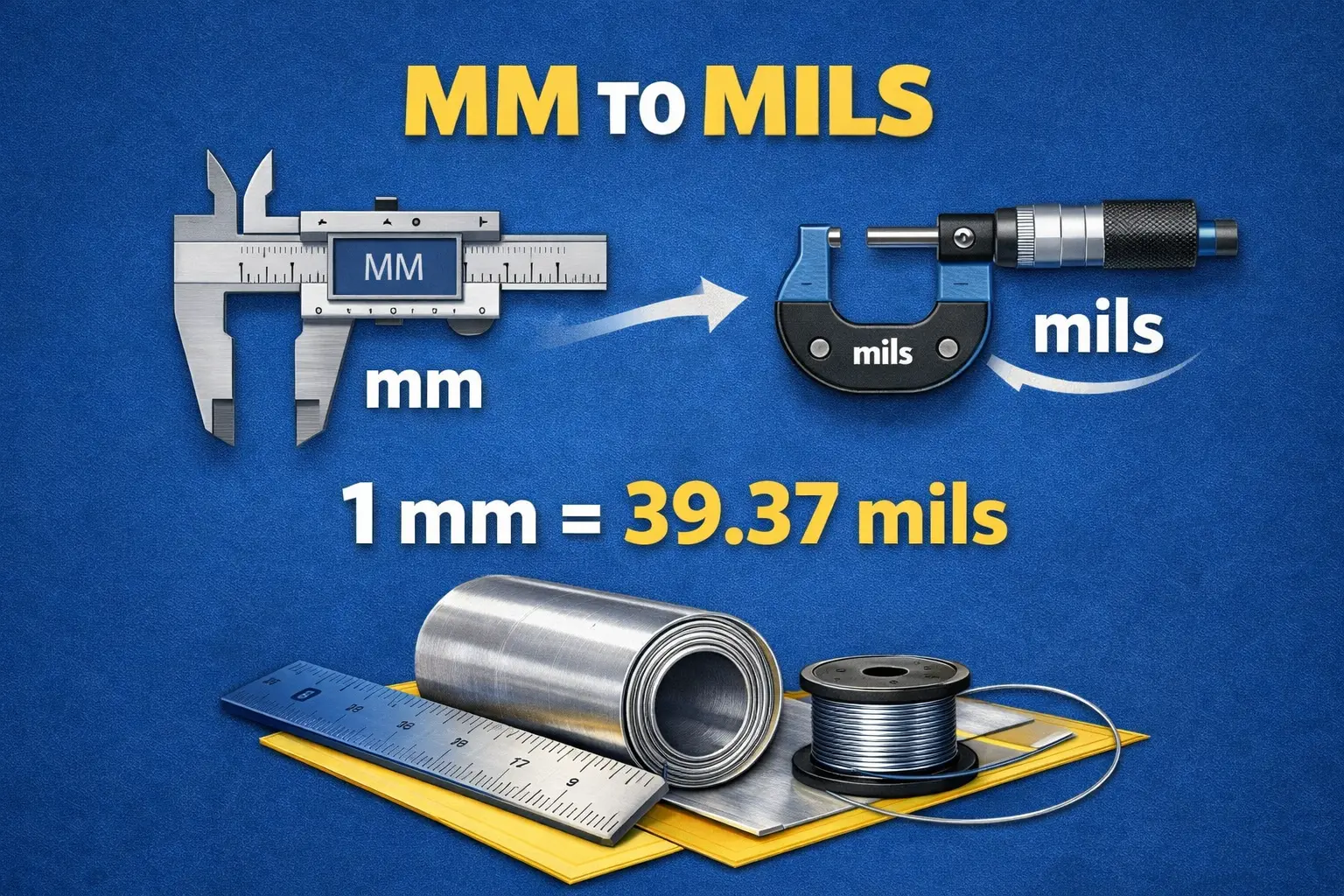
Understanding mm to mils Conversion
Precision measurement is crucial in modern manufacturing, engineering, electronics, and technology sectors. Two commonly used units for measuring very small dimensions are millimeters (mm) and mils (thousandths of an inch). Understanding how to convert mm to mils and mils to mm is essential for professionals working with international specifications, PCB design, coating thickness, sheet metal fabrication, and precision machining.
While millimeters are part of the metric system used worldwide, mils remain prevalent in American industries, particularly in electronics manufacturing, wire gauge standards, coating applications, and precision engineering. The ability to convert between these units seamlessly ensures accuracy across different measurement systems and international collaborations.
🎯 Key Takeaways
- Basic conversion: 1 mm = 39.37 mils | 1 mil = 0.0254 mm
- Quick formula: Multiply mm by 39.37 to get mils; multiply mils by 0.0254 to get mm
- Common examples: 1 mil = 0.0254 mm | 6 mil = 0.1524 mm | 10 mm = 393.7 mils
- Mental math trick: 1 mm ≈ 40 mils for quick field approximations
- Applications: Essential for PCB design, coating thickness, wire gauges, and international manufacturing
- Precision matters: Always use the exact conversion factor (39.3701) for critical engineering applications
- Don't confuse units: Mils and millimeters are vastly different - 1 mm is about 39 times larger than 1 mil
- Industry standards: US electronics and coating industries commonly use mils; most other countries use mm
What is a Mil?
A mil (also called a "thou" or "thousandth") is a unit of length equal to one-thousandth of an inch (0.001 inch). Despite sharing a similar name, a mil should not be confused with a millimeter, milliliter, or the angular measurement "mil" used in military applications.
Key Facts About Mils
- Symbol: mil or thou
- Definition: 1 mil = 0.001 inch = 1/1000 inch
- Origin: Derived from the Latin "mille" meaning thousand
- Common in: United States, electronics industry, wire gauge measurements, coating thickness
- Typical applications: PCB copper thickness, paint coating, plastic film thickness, wire diameter
Mils are extensively used in the electronics industry for specifying PCB (Printed Circuit Board) copper thickness, trace widths, and clearances. For example, standard PCB copper thickness is often specified as 1 oz copper, which equals 1.4 mils (35 micrometers). In coating applications, paint thickness is commonly measured in mils to ensure proper coverage and durability.
What is a Millimeter?
A millimeter (mm) is a metric unit of length equal to one-thousandth of a meter. It's part of the International System of Units (SI) and is the standard measurement used globally for precision dimensions.
Key Facts About Millimeters
- Symbol: mm
- Definition: 1 mm = 0.001 meter = 1/1000 meter
- Part of: International System of Units (SI), metric system
- Used in: All countries except the United States, Liberia, and Myanmar
- Advantages: Decimal-based, easy conversions, universally recognized
Millimeters are the preferred unit in most technical drawings, engineering specifications, scientific measurements, and manufacturing processes worldwide. Modern CNC machines, 3D printers, and precision instruments commonly work in millimeters due to the metric system's simplicity and consistency.
Conversion Formulas: The Mathematics Behind mm and mils
MM to Mils Conversion
To convert millimeters to mils, use the following formula:
Formula: Mils = MM × 39.3701
Simplified: Mils ≈ MM × 39.37
Mils to MM Conversion
To convert mils to millimeters (mil to mm), use this formula:
Formula: MM = Mils × 0.0254
Alternative: MM = Mils ÷ 39.3701
Understanding the Conversion Factor
The conversion factor 39.3701 comes from the relationship between inches and millimeters:
- 1 inch = 25.4 mm (exactly)
- 1 mil = 0.001 inch
- Therefore: 1 mm = 1 ÷ 0.0254 = 39.3701 mils
Practical Conversion Examples
Example 1: Convert 1 mil to mm
Let's convert 1 mil to millimeters:
- Start with 1 mil
- Use the formula: MM = Mils × 0.0254
- Calculate: 1 × 0.0254 = 0.0254
- Result: 1 mil = 0.0254 mm
This is approximately 25.4 micrometers (μm), which is about the thickness of a human hair or a standard plastic shopping bag.
Example 2: Convert 6 mil to mm
To convert 6 mils to millimeters:
- Start with 6 mils
- Use the formula: MM = Mils × 0.0254
- Calculate: 6 × 0.0254 = 0.1524
- Result: 6 mil = 0.1524 mm (approximately 0.15 mm)
This thickness is common for standard lamination film, credit cards, or medium-weight plastic sheeting used in packaging and industrial applications.
Example 3: Convert 2.5 mm to mils
Let's convert 2.5 millimeters to mils:
- Start with 2.5 mm
- Use the formula: Mils = MM × 39.3701
- Calculate: 2.5 × 39.3701 = 98.425
- Result: 2.5 mm ≈ 98.43 mils (rounded to 98 mils)
Example 4: Convert 10 mm to mils
To convert 10 millimeters to mils:
- Start with 10 mm
- Apply: Mils = 10 × 39.3701
- Calculate: 393.701
- Result: 10 mm = 393.7 mils (approximately 394 mils)
Quick Conversion Tables
Mils to MM Conversion Table
| Mils (thousandths) | Millimeters (mm) | Micrometers (μm) |
|---|---|---|
| 1 mil | 0.0254 mm | 25.4 μm |
| 2 mil | 0.0508 mm | 50.8 μm |
| 5 mil | 0.127 mm | 127 μm |
| 6 mil | 0.1524 mm | 152.4 μm |
| 10 mil | 0.254 mm | 254 μm |
| 20 mil | 0.508 mm | 508 μm |
| 50 mil | 1.27 mm | 1,270 μm |
| 100 mil | 2.54 mm | 2,540 μm |
MM to Mils Conversion Table
| Millimeters (mm) | Mils (thousandths) | Inches (in) |
|---|---|---|
| 0.1 mm | 3.94 mil | 0.00394 in |
| 0.5 mm | 19.69 mil | 0.01969 in |
| 1 mm | 39.37 mil | 0.03937 in |
| 2 mm | 78.74 mil | 0.07874 in |
| 5 mm | 196.85 mil | 0.19685 in |
| 10 mm | 393.70 mil | 0.3937 in |
| 25 mm | 984.25 mil | 0.98425 in |
| 50 mm | 1,968.5 mil | 1.9685 in |
Real-World Applications of mm to mils Conversion
1. Printed Circuit Board (PCB) Design
PCB manufacturers worldwide use both metric and imperial measurements. Copper thickness is typically specified in ounces (oz) or mils in the US, but millimeters or micrometers internationally. Standard PCB specifications include:
- 1 oz copper: 1.4 mils (0.0356 mm or 35.6 μm)
- 2 oz copper: 2.8 mils (0.0711 mm or 71.1 μm)
- Trace width minimum: Often 6-8 mils (0.15-0.20 mm)
- Clearance spacing: Typically 5-10 mils (0.127-0.254 mm)
Engineers designing PCBs must convert mm to mil and vice versa to ensure compatibility with manufacturing capabilities across different regions. Use our length converter tool for instant PCB dimension conversions.
2. Coating and Plating Thickness
Industrial coating applications, including paint, powder coating, galvanization, and anodizing, often specify thickness in mils in the United States but millimeters elsewhere:
- Automotive paint: 4-6 mils (0.10-0.15 mm)
- Industrial powder coating: 2-4 mils (0.05-0.10 mm)
- Zinc galvanizing: 1.5-3 mils (0.04-0.08 mm)
- Anodizing: 0.2-1 mil (0.005-0.025 mm)
3. Sheet Metal and Manufacturing
Sheet metal gauge systems vary between metric and imperial standards. Converting between mm and mil ensures proper material selection:
- Standard aluminum foil: 0.6-1 mil (0.015-0.025 mm)
- Beverage can: 4-5 mils (0.10-0.13 mm)
- Sheet metal (18 gauge): 48 mils (1.22 mm)
Explore more material conversions with our comprehensive converter collection.
4. Wire and Cable Industry
Wire gauge standards like AWG (American Wire Gauge) use mils for diameter specifications, while international standards use millimeters. Accurate mil to millimeter conversion is critical for:
- Selecting proper wire sizes for electrical installations
- Ensuring cable compatibility across regions
- Meeting safety and regulatory requirements
- Insulation thickness specifications
5. Plastic Film and Packaging
Plastic film thickness for packaging, lamination, and industrial applications:
- Standard food wrap: 0.5 mil (0.0127 mm)
- Garbage bag: 0.7-1.5 mil (0.018-0.038 mm)
- Lamination film: 3-10 mil (0.076-0.254 mm)
Pro Tips for Accurate Millimeter to Mil Conversion
For professional work requiring high precision, always use our free online length converter rather than manual calculations. This eliminates human error and provides instant, accurate results for mm to mil and mil to mm conversions.
Different industries have different precision requirements. PCB manufacturing might require accuracy to 0.1 mil, while painting applications may round to whole mils. Always check the tolerance specifications for your specific application before rounding conversion results.
Keep a laminated conversion chart at your workstation with common mil to mm conversions (1, 2, 5, 6, 10, 20, 50, 100 mils) for instant reference. This saves time and reduces calculation errors in fast-paced manufacturing environments.
For quick mental estimates in the field: 1 mm ≈ 40 mils (actual: 39.37). This 1.6% error is acceptable for rough calculations but should never replace precise measurements for manufacturing tolerances or critical dimensions.
When working with measurements smaller than 10 mils (0.254 mm), consider using micrometers (μm) instead. 1 mil = 25.4 μm. Micrometers provide clearer communication and reduce confusion in precision work like semiconductor manufacturing or thin-film applications.
Common Conversion Mistakes to Avoid
- Confusing mil with millimeter: Remember that 1 mil is much smaller than 1 mm (about 39 times smaller)
- Using incorrect conversion factors: Always use 0.0254 for mil to mm or 39.3701 for mm to mil
- Rounding too early: Maintain precision through calculations and round only the final result
- Forgetting unit labels: Always specify whether you're working in mils or mm to prevent costly errors
- Mixing angular mils with length mils: The military uses "mil" for angular measurement (1/6400 of a circle) - completely different from thousandths of an inch
Conclusion
Mastering mm to mils and mils to mm conversions is essential for professionals working in engineering, electronics, manufacturing, and any field requiring precision measurements across metric and imperial systems. The fundamental conversion factors - 1 mm = 39.37 mils and 1 mil = 0.0254 mm - enable seamless communication and accurate specifications in international projects.
Whether you're designing PCBs with 6 mil trace widths, specifying coating thickness, selecting wire gauges, or working with international manufacturing partners, accurate millimeter to mil conversion ensures quality, safety, and compatibility. Remember that precision matters: using the exact conversion factor prevents costly errors in manufacturing and ensures compliance with specifications.
For quick and accurate conversions, bookmark our free length converter tool and explore more unit conversion calculators for all your measurement needs. Master these conversions to enhance your professional capabilities and ensure precision in every project.