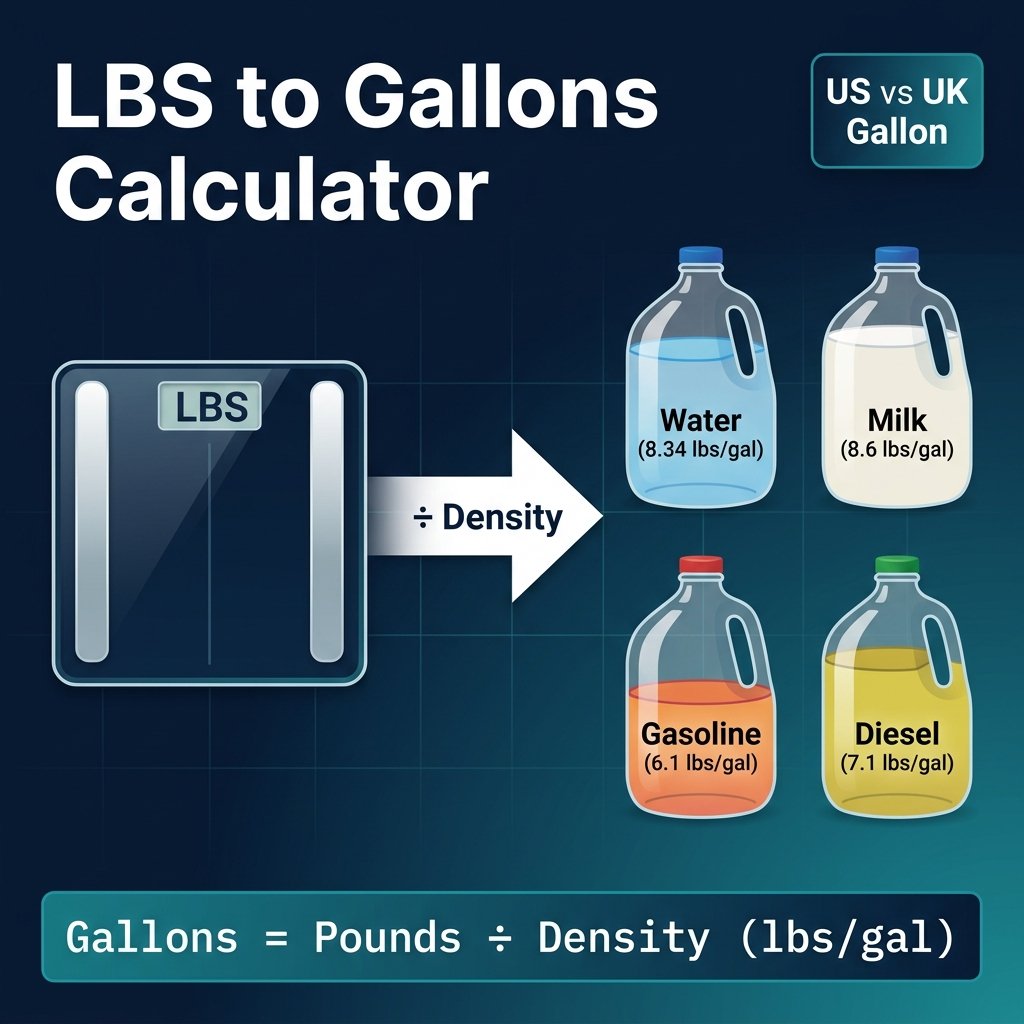
Whether you are calculating how much water fits in a tank, figuring out how many gallons a shipment of diesel weighs, or converting a recipe from weight to volume — the question is the same: how do you convert lbs to gallons? The answer is not a fixed ratio. Unlike converting kilograms to pounds (which is always the same multiplier), pounds-to-gallons depends entirely on the density of the specific liquid you are working with.
This complete guide explains the lbs to gallons formula, provides a density reference table for 15+ common liquids, covers the US vs UK gallon difference, gives fully worked examples for water, milk, gasoline, diesel, and cooking oil, and includes a free inline calculator below. Let's start with the direct answer.
The Quick Answer: LBS to Gallons Formula
Key Takeaways
- Gallons = Pounds ÷ Density (lbs/gal) — this is always the formula
- 1 gallon of water = 8.34 lbs; therefore 1 lb of water = 0.1199 gallons
- Different liquids have different densities — you cannot use a single fixed conversion factor for all liquids
- A US gallon (3.785 L) is about 20% smaller than a UK gallon (4.546 L)
- Temperature affects density — all values below are at 68°F (20°C)
- Use the free calculator in Section 3 for instant, accurate results
Table of Contents
- What Is LBS to Gallons Conversion?
- The Pounds to Gallons Formula (Explained)
- Free LBS to Gallons Calculator
- Density of Common Liquids (lbs/gal Table)
- Worked Examples: Water, Milk, Gasoline, Diesel
- Full LBS to Gallons Conversion Tables
- US Gallon vs UK Gallon: The Critical Difference
- LB to ML and Pounds to Fluid Ounces
- Real-World Use Cases
- Frequently Asked Questions (10 FAQs)
What Is LBS to Gallons Conversion?
Converting pounds (lbs) to gallons is a weight-to-volume conversion — it appears constantly in cooking, fuel logistics, agriculture, industrial chemical handling, aquarium sizing, pool calculations, and scientific lab work. Unlike a simple unit swap (such as kilometres to miles), this conversion involves two fundamentally different physical quantities:
- Pounds (lbs) measure mass or weight
- Gallons measure volume
The bridge between them is density — defined as mass per unit volume. Different liquids have different densities, which is why 1 pound of water occupies a different volume than 1 pound of gasoline, milk, honey, or mercury. This is the central concept you need to understand before performing any lbs-to-gallons calculation.
The Pounds to Gallons Formula (Explained)
The lbs to gallons formula comes directly from the definition of density (Density = Mass ÷ Volume), rearranged to solve for Volume:
Gallons = Pounds ÷ Density (lbs/gal)
Reverse Formula — Gallons to Pounds:
Pounds = Gallons × Density (lbs/gal)
Step-by-Step: How to Convert Pounds to Gallons
- Identify the liquid. Determine which liquid you are converting — water, milk, gasoline, diesel, cooking oil, etc. Each has a unique density.
- Find the density in lbs/gal. Use the table in Section 4 below. Example: Water = 8.34 lbs/gal, Regular Gasoline = 6.1 lbs/gal.
- Divide pounds by density. Apply the formula: Gallons = Pounds ÷ Density (lbs/gal). Example: 100 lbs of water ÷ 8.34 = 11.99 gallons.
- Verify (optional). Multiply gallons × density to confirm you get back to the original pounds value.
Free LBS to Gallons Calculator
Enter the weight in pounds, select your liquid, and click Convert. The calculator shows US gallons, litres, quarts, and fluid ounces instantly.
Density of Common Liquids (lbs/gal Reference Table)
Before converting pounds to gallons, you need the liquid's density in pounds per US gallon (lbs/gal) at room temperature (68°F / 20°C). Here are the most commonly needed values:
Complete Liquid Density Reference Table
| Liquid | lbs / US Gallon | kg / Litre | lbs / UK Gallon |
|---|---|---|---|
| Water (68°F / 20°C) | 8.34 | 1.000 | 10.02 |
| Water (39°F / 4°C — max density) | 8.345 | 1.0003 | 10.02 |
| Seawater (avg 3.5% salinity) | 8.56 | 1.025 | 10.28 |
| Whole Milk | 8.60 | 1.030 | 10.33 |
| Skim Milk | 8.40 | 1.007 | 10.08 |
| Regular Gasoline (87 octane) | 6.10 | 0.731 | 7.32 |
| Premium Gasoline (91–93 octane) | 6.25 | 0.749 | 7.50 |
| Diesel Fuel (No. 2) | 7.10 | 0.851 | 8.52 |
| Diesel Fuel (No. 1) | 6.80 | 0.815 | 8.16 |
| Jet Fuel (Jet-A) | 6.74 | 0.808 | 8.09 |
| Kerosene | 6.82 | 0.817 | 8.18 |
| Cooking / Vegetable Oil | 7.70 | 0.920 | 9.24 |
| Olive Oil | 7.60 | 0.911 | 9.12 |
| Motor Oil (SAE 10W-30) | 7.30 | 0.875 | 8.76 |
| Ethanol (100%) | 6.57 | 0.789 | 7.88 |
| Honey | 11.90 | 1.420 | 14.28 |
| Liquid Propane (LPG) | 5.30 | 0.635 | 6.36 |
| Mercury | 112.00 | 13.534 | 134.40 |
All values at standard room temperature (68°F / 20°C) unless otherwise noted.
Worked Examples: Water, Milk, Gasoline, Diesel
💧 Water: Pounds to Gallons
Water density = 8.34 lbs per US gallon at room temperature (68°F / 20°C). Water is the most common reference liquid for lbs-to-gallons conversions.
- 1 lb of water = 1 ÷ 8.34 = 0.1199 gallons (≈ 19.2 fl oz)
- 5 lbs of water = 5 ÷ 8.34 = 0.5995 gallons
- 10 lbs of water = 10 ÷ 8.34 = 1.199 gallons
- 25 lbs of water = 25 ÷ 8.34 = 2.998 gallons (≈ 3 gallons)
- 50 lbs of water = 50 ÷ 8.34 = 5.995 gallons
- 100 lbs of water = 100 ÷ 8.34 = 11.990 gallons
🥛 Milk: Pounds to Gallons
Whole milk density = 8.60 lbs per US gallon. Milk is slightly denser than water due to dissolved fat, protein, and lactose.
- 1 lb of milk = 1 ÷ 8.60 = 0.1163 gallons
- 10 lbs of milk = 10 ÷ 8.60 = 1.163 gallons
- 50 lbs of milk = 50 ÷ 8.60 = 5.814 gallons
⛽ Gasoline: Pounds to Gallons
Regular gasoline density = 6.1 lbs per US gallon at 60°F (the standard petroleum reference temperature). Gasoline is significantly lighter than water.
- 1 lb of gasoline = 1 ÷ 6.1 = 0.164 gallons
- 10 lbs of gasoline = 10 ÷ 6.1 = 1.639 gallons
- 50 lbs of gasoline = 50 ÷ 6.1 = 8.197 gallons
- 100 lbs of gasoline = 100 ÷ 6.1 = 16.39 gallons
🛢 Diesel: Pounds to Gallons
Diesel (No. 2) density = 7.1 lbs per US gallon. Diesel is heavier than gasoline because it contains larger hydrocarbon molecules.
- 1 lb of diesel = 1 ÷ 7.1 = 0.141 gallons
- 10 lbs of diesel = 10 ÷ 7.1 = 1.408 gallons
- 100 lbs of diesel = 100 ÷ 7.1 = 14.085 gallons
Full LBS to Gallons Conversion Tables
💧 Water: LBS to US Gallons Conversion Table
| Pounds (lbs) | US Gallons | UK Gallons | Quarts | Litres |
|---|---|---|---|---|
| 1 lb | 0.1199 gal | 0.0999 gal | 0.480 qt | 0.454 L |
| 2 lbs | 0.2398 gal | 0.1997 gal | 0.960 qt | 0.907 L |
| 5 lbs | 0.5995 gal | 0.4993 gal | 2.398 qt | 2.268 L |
| 10 lbs | 1.199 gal | 0.999 gal | 4.797 qt | 4.536 L |
| 15 lbs | 1.799 gal | 1.498 gal | 7.194 qt | 6.804 L |
| 20 lbs | 2.398 gal | 1.997 gal | 9.593 qt | 9.072 L |
| 25 lbs | 2.998 gal | 2.497 gal | 11.990 qt | 11.340 L |
| 30 lbs | 3.597 gal | 2.996 gal | 14.388 qt | 13.608 L |
| 40 lbs | 4.796 gal | 3.994 gal | 19.184 qt | 18.144 L |
| 50 lbs | 5.995 gal | 4.993 gal | 23.981 qt | 22.680 L |
| 75 lbs | 8.993 gal | 7.490 gal | 35.971 qt | 34.019 L |
| 100 lbs | 11.990 gal | 9.986 gal | 47.962 qt | 45.359 L |
| 200 lbs | 23.981 gal | 19.971 gal | 95.923 qt | 90.718 L |
| 500 lbs | 59.952 gal | 49.928 gal | 239.808 qt | 226.796 L |
Multi-Liquid LBS to Gallons Reference (10, 25, 50, 100 lbs)
| Liquid | lbs/gal | 10 lbs | 25 lbs | 50 lbs | 100 lbs |
|---|---|---|---|---|---|
| Water | 8.34 | 1.199 gal | 2.998 gal | 5.995 gal | 11.990 gal |
| Whole Milk | 8.60 | 1.163 gal | 2.907 gal | 5.814 gal | 11.628 gal |
| Seawater | 8.56 | 1.168 gal | 2.921 gal | 5.841 gal | 11.682 gal |
| Cooking Oil | 7.70 | 1.299 gal | 3.247 gal | 6.494 gal | 12.987 gal |
| Diesel (No. 2) | 7.10 | 1.408 gal | 3.521 gal | 7.042 gal | 14.085 gal |
| Gasoline | 6.10 | 1.639 gal | 4.098 gal | 8.197 gal | 16.393 gal |
| Ethanol | 6.57 | 1.522 gal | 3.806 gal | 7.610 gal | 15.221 gal |
| Honey | 11.90 | 0.840 gal | 2.101 gal | 4.202 gal | 8.403 gal |
US Gallon vs UK Gallon: The Critical Difference
When you search for lbs to gallons, almost all results use the US gallon. However, the UK uses the Imperial gallon, which is approximately 20% larger. This difference is critical — using the wrong gallon can cause a 20% error in your calculations.
🇺🇸 US Gallon
🇬🇧 UK (Imperial) Gallon
| Measurement | US Gallon | UK (Imperial) Gallon |
|---|---|---|
| Volume | 3.785 litres | 4.546 litres |
| Water weight at 68°F | 8.34 lbs | 10.02 lbs |
| Fluid ounces | 128 fl oz (US) | 160 fl oz (Imperial) |
| Quarts | 4 US quarts | 4 Imperial quarts |
| Pints | 8 US pints | 8 Imperial pints |
| Common use | United States | United Kingdom |
LB to ML and Pounds to Fluid Ounces
Many users also need to convert pounds to millilitres (lb to ml) or pounds to fluid ounces. Here are the formulas and quick reference values for water:
LB to ML Formula
ml = (Pounds × 453.592) ÷ Density (g/ml)
For water (density = 1 g/ml): ml = Pounds × 453.592
Example: 1 lb of water = 453.6 ml | 2 lbs of water = 907.2 ml
Pounds to Millilitres — Quick Reference (Water)
| Pounds (lbs) | Millilitres (ml) | Fluid Ounces (US) |
|---|---|---|
| 0.5 lb | 226.8 ml | 7.67 fl oz |
| 1 lb | 453.6 ml | 15.34 fl oz |
| 2 lbs | 907.2 ml | 30.68 fl oz |
| 5 lbs | 2,268 ml | 76.7 fl oz |
| 10 lbs | 4,536 ml | 153.4 fl oz |
Convert LBS to Fluid Ounces
For water: Fluid Oz = Pounds × (128 ÷ 8.34) = Pounds × 15.34
Example: 3 lbs of water = 3 × 15.34 = 46.02 fluid ounces
Real-World Use Cases
Understanding how to convert pounds to gallons is essential across many industries and everyday situations:
Fuel Logistics and Aviation
Aircraft and military fuel is purchased in pounds (for weight-and-balance calculations) but dispensed in gallons. Jet fuel (Jet-A) weighs approximately 6.74 lbs/gal, so 10,000 lbs of Jet-A = 10,000 ÷ 6.74 ≈ 1,484 gallons. Truck drivers also convert diesel weight to volume for fuel tax calculations.
Commercial Cooking and Food Production
Large-batch recipes may specify ingredients in pounds while commercial kitchen equipment is calibrated in gallons. Converting pounds of milk to gallons or pounds of cooking oil to gallons is a daily task in food production facilities.
Agriculture and Irrigation
Fertiliser and pesticide application rates are often expressed in pounds per acre, but spray equipment is calibrated in gallons per minute. Converting between the two requires knowing the liquid's density.
Aquariums and Swimming Pools
Engineers and builders calculate structural load by converting the weight of water in a pool or tank to gallons to determine tank volume and verify that the floor or structure can support the weight. One cubic foot of water weighs 62.4 lbs and holds 7.48 US gallons.
When You Need LBS to Gallons Conversion
- You know the weight of a liquid but need to know how many gallons it fills
- You are sizing a fuel tank or storage vessel based on weight capacity
- You are comparing fuel efficiency between diesel and gasoline (they have different weights per gallon)
- You need to calculate shipping weight from a known gallon volume
- You are checking a recipe that gives liquid amounts in pounds rather than cups or gallons
Frequently Asked Questions
The 10 most common questions about converting lbs to gallons, formatted for fast, direct answers.
Conclusion: LBS to Gallons Made Simple
Converting pounds to gallons is a weight-to-volume conversion that always requires one additional piece of information: the density of the liquid in pounds per gallon. The formula is simple — Gallons = Pounds ÷ Density — but you must use the correct density for your specific liquid.
For water: 1 US gallon = 8.34 lbs. For gasoline: 1 gallon ≈ 6.1 lbs. For milk: 1 gallon ≈ 8.6 lbs. For diesel: 1 gallon ≈ 7.1 lbs. Always confirm whether you are using US gallons or UK Imperial gallons, as they differ by approximately 20%.
Use the free LBS to Gallons Calculator above for instant, accurate conversions across 15 different liquids. For additional volume conversions, explore our Volume Converter Tool.
• Water: 8.34 lbs/gal | 1 lb = 0.1199 gal | 1 gal = 8.34 lbs
• Whole Milk: 8.60 lbs/gal | 1 lb = 0.1163 gal
• Gasoline: 6.10 lbs/gal | 1 lb = 0.164 gal
• Diesel: 7.10 lbs/gal | 1 lb = 0.141 gal
• Cooking Oil: 7.70 lbs/gal | 1 lb = 0.130 gal
• Seawater: 8.56 lbs/gal | 1 lb = 0.117 gal
• Ethanol: 6.57 lbs/gal | 1 lb = 0.152 gal
• Honey: 11.90 lbs/gal | 1 lb = 0.084 gal