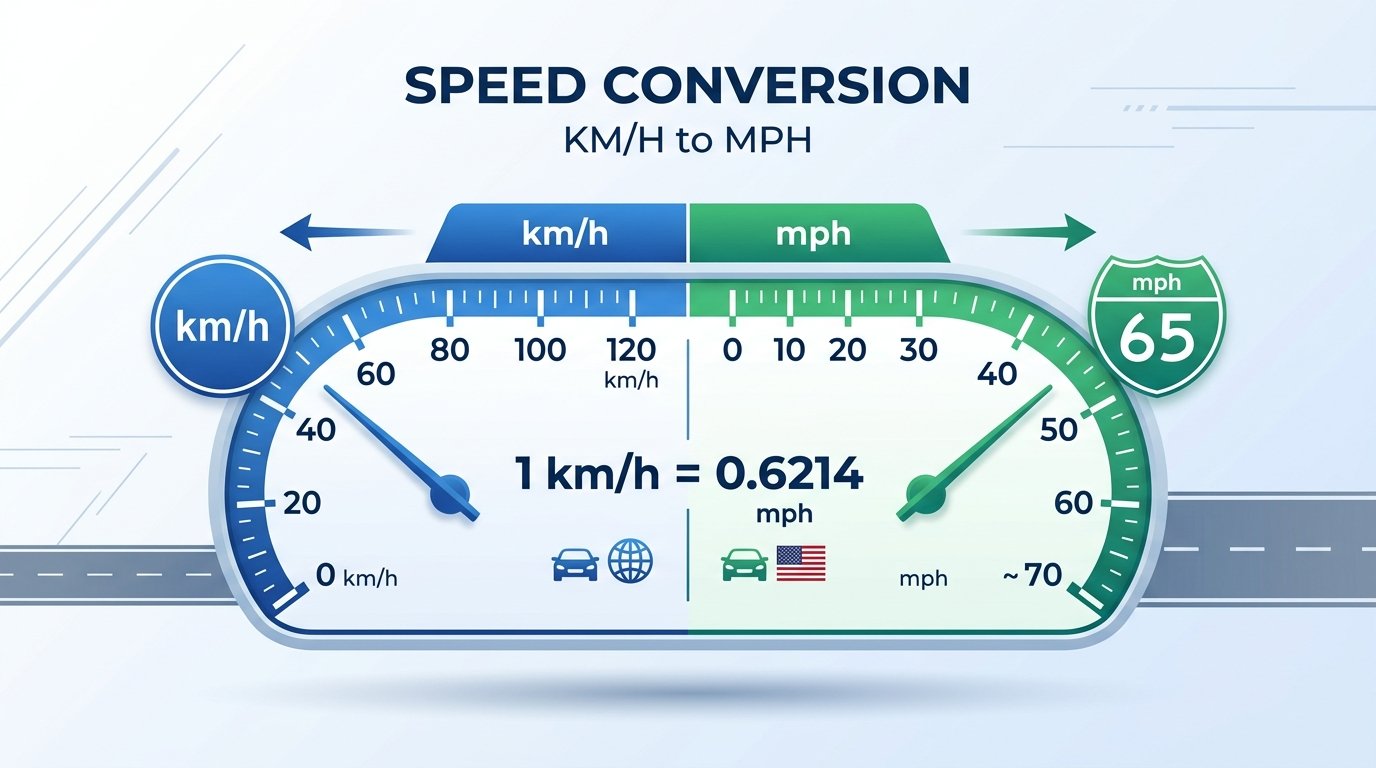
Whether you're renting a car abroad, reading a European speed limit sign, or following international sports coverage, knowing how to express km per hour in miles is a genuinely useful skill. The two units measure the same thing — speed — but they belong to different measurement systems used in different parts of the world. This guide explains the exact conversion formula, walks through real examples, and gives you a quick-reference table so you never have to guess again.
Formula: mph = km/h × 0.621371
Example: 100 km/h = 100 × 0.621371 = 62.14 mph
🔑 Key Takeaways
- 1 km/h = 0.621371 mph (exact conversion factor)
- 1 mph = 1.609344 km/h (reverse conversion factor)
- Formula: mph = km/h × 0.621371
- 100 km/h ≈ 62.14 mph — the most commonly searched conversion
- The conversion factor comes from the defined length of one international mile: 1 mile = 1.609344 km
- Most countries use km/h; the US and UK use mph
📋 Table of Contents
- km/h vs mph: What Is the Difference?
- The km/h to mph Conversion Formula
- Free km/h to mph Calculator
- Worked Examples: Convert km/h to mph
- km/h to mph Conversion Table
- Common Speed Benchmarks in Both Units
- Practical Use Cases for This Conversion
- Reverse Conversion: mph to km/h
- Frequently Asked Questions
km/h vs mph: What Is the Difference?
Both kilometres per hour (km/h) and miles per hour (mph) are units of speed. Speed measures how much distance an object covers in a given amount of time. The difference between km/h and mph is simply the unit of distance being used: kilometres in the metric system, and miles in the imperial system.
One kilometre is exactly 1,000 metres. One international mile is defined as exactly 1.609344 kilometres. Because a mile is longer than a kilometre, the same speed expressed in mph will always be a smaller number than when expressed in km/h. For instance, a car travelling at 100 km/h is only doing about 62 mph — not 100.
Most countries around the world use km/h as their official speed unit on road signs and vehicle speedometers. The notable exceptions are the United States and the United Kingdom, which officially use mph. Some car speedometers show both units, but most everyday drivers only read one scale — which is exactly why this conversion matters.
The km/h to mph Conversion Formula
The conversion is based on the defined relationship between miles and kilometres. Since 1 international mile = 1.609344 km exactly, dividing gives us the factor to go from km to miles:
1 km = 1 ÷ 1.609344 miles = 0.621371 miles
Because speed is distance per unit time (and the time unit — hours — is the same in both km/h and mph), the same factor applies directly to speed:
mph = km/h × 0.621371
Reverse Formula (mph to km/h):
km/h = mph × 1.609344
The factor 0.621371 is the exact reciprocal of 1.609344. Both are exact, internationally standardised values.
For quick mental maths, a useful approximation is to multiply by 0.6 (or divide by 1.6). This gives you a close estimate — accurate enough for reading road signs — though the precise factor is 0.621371 for any calculation that needs to be exact.
⚡ Free km/h to mph Calculator
Enter any speed in km/h below to instantly convert it to miles per hour. The calculator uses the exact conversion factor of 0.621371:
km/h to mph Converter
Type a speed in kilometres per hour to see the equivalent in miles per hour:
Worked Examples: Convert km/h to mph
Let's work through the most commonly searched conversions step by step. Each example applies the formula: mph = km/h × 0.621371.
Example 1: 50 km/h in mph
50 × 0.621371 = 31.07 mph. This is a common urban speed limit in many European and Asian cities.
Example 2: 80 km/h in mph
80 × 0.621371 = 49.71 mph. A typical rural road speed limit in metric-system countries, equivalent to just under 50 mph.
Example 3: 100 km/h in mph
100 × 0.621371 = 62.14 mph. This is the most commonly searched km per hour in miles conversion, representing the standard motorway limit in many countries including Australia, Canada, and most of Europe.
Example 4: 110 km/h in mph
110 × 0.621371 = 68.35 mph. Common highway speed limit in countries like India, New Zealand, and South Africa.
Example 5: 120 km/h in mph
120 × 0.621371 = 74.56 mph. A widely used motorway limit across the European Union.
Example 6: 130 km/h in mph
130 × 0.621371 = 80.78 mph. The highest legal highway speed in France, Poland, and several other European countries.
km/h to mph Conversion Table
Use this quick-reference table for common speed values. All results are rounded to two decimal places using the conversion factor 0.621371.
| km/h | mph (exact) | mph (rounded) |
|---|---|---|
| 10 km/h | 6.21371 mph | 6.21 mph |
| 20 km/h | 12.42742 mph | 12.43 mph |
| 30 km/h | 18.64114 mph | 18.64 mph |
| 40 km/h | 24.85485 mph | 24.85 mph |
| 50 km/h | 31.06856 mph | 31.07 mph |
| 60 km/h | 37.28227 mph | 37.28 mph |
| 70 km/h | 43.49598 mph | 43.50 mph |
| 80 km/h | 49.70969 mph | 49.71 mph |
| 90 km/h | 55.92340 mph | 55.92 mph |
| 100 km/h | 62.13712 mph | 62.14 mph |
| 110 km/h | 68.35083 mph | 68.35 mph |
| 120 km/h | 74.56454 mph | 74.56 mph |
| 130 km/h | 80.77825 mph | 80.78 mph |
| 140 km/h | 86.99196 mph | 86.99 mph |
| 150 km/h | 93.20567 mph | 93.21 mph |
| 200 km/h | 124.27424 mph | 124.27 mph |
Common Speed Benchmarks in Both Units
Putting the numbers in context makes conversions more intuitive. Here are some real-world speed benchmarks you can use as mental reference points:
- Walking speed: ~5 km/h ≈ 3.1 mph
- Cycling speed: ~25 km/h ≈ 15.5 mph
- Urban speed limit (most countries): 50 km/h ≈ 31 mph
- Rural road speed limit: 80–100 km/h ≈ 50–62 mph
- Motorway speed limit (EU): 120–130 km/h ≈ 75–81 mph
- US Interstate speed limit: ~110–130 km/h (posted as 70–80 mph)
- Commercial aircraft cruising speed: ~900 km/h ≈ 559 mph
- Speed of sound (at sea level): 1,235 km/h ≈ 767 mph
Knowing these reference points means you can quickly sanity-check a conversion. If someone tells you a car was travelling at 160 km/h, you immediately know it's about 100 mph — clearly above any standard road limit.
Practical Use Cases for This Conversion
Knowing how to express km per hour in miles comes up more often than you might think. Here are the most common real-world situations:
Driving Abroad
If you're from the US or UK and rent a car in Europe, Australia, or Canada, the speedometer will likely show km/h — or both scales. Understanding that 100 km/h = 62 mph instantly tells you whether you're within the local limit.
Fitness and Sports Tracking
Many fitness apps, GPS watches, and cycling computers let you choose your preferred speed unit. Athletes competing internationally often need to report or compare performance in the non-native unit. A runner hitting 15 km/h is running at about 9.3 mph, which translates to a 6.4-minute mile pace.
Importing or Buying a Vehicle
Vehicle specifications — top speed, acceleration benchmarks — are published in the manufacturer's local unit. A European car with a top speed of 250 km/h is capable of approximately 155 mph. Buyers and enthusiasts frequently need this conversion.
Weather and Aviation Reports
Wind speeds in weather forecasts are reported in km/h in most countries and in mph in the US and UK. A Category 1 hurricane wind threshold of 119 km/h is the same as 74 mph. Aviation uses knots, but understanding the relationship between km/h and mph helps when reading international weather briefings. Our mph to kph speed converter guide covers this in more detail.
Science and Engineering
In physics problems and engineering calculations, speed values must be in consistent units. Converting between systems is a daily task in international research, vehicle dynamics, and fluid mechanics.
Reverse Conversion: mph to km/h
Going the other direction — from miles per hour back to kilometres per hour — is equally straightforward. Just multiply by the inverse factor:
km/h = mph × 1.609344
Examples:
30 mph = 30 × 1.609344 = 48.28 km/h
60 mph = 60 × 1.609344 = 96.56 km/h
70 mph = 70 × 1.609344 = 112.65 km/h
100 mph = 100 × 1.609344 = 160.93 km/h
The factor 1.609344 is exact — it is the defined length of one international mile in kilometres, agreed upon in 1959 by the US, UK, Canada, Australia, New Zealand, and South Africa. Because it is defined (not measured), there is no rounding error in the conversion factor itself; only the result may be rounded for readability.
For more on how distance units relate to each other, see our guide on metric vs. imperial measurement systems, which explains the full history and structure of both systems.
Summary: Everything You Need to Know
Converting km per hour in miles comes down to one number: 0.621371. Multiply any km/h value by this factor and you get the exact equivalent in mph. The factor is derived from the defined length of one international mile (1.609344 km), so it is exact and does not vary.
Whether you're reading a road sign, tracking fitness performance, reviewing a car specification, or solving a physics problem, the process is always the same: multiply km/h by 0.621371 or divide by 1.609344. Use the calculator above for any value, or refer to the reference table for common speeds at a glance.
For related conversions, you might also find our articles on converting Celsius to Fahrenheit and square feet to square metres helpful if you're navigating between measurement systems more broadly.
Frequently Asked Questions (FAQs)
How do you convert km/h to mph?
Multiply the speed in km/h by 0.621371. Formula: mph = km/h × 0.621371. Example: 100 km/h = 100 × 0.621371 = 62.14 mph.
How many miles per hour is 100 km/h?
100 km/h = 62.14 mph. This is one of the most commonly needed conversions — 100 km/h is the standard motorway speed limit in many countries.
What is 120 km/h in miles per hour?
120 km/h = 74.56 mph. Calculation: 120 × 0.621371 = 74.56 mph. This is the maximum speed limit on many European motorways.
What is the conversion factor from km/h to mph?
The exact conversion factor is 0.621371. It comes from the definition that 1 international mile = 1.609344 kilometres, so 1 km = 1 ÷ 1.609344 = 0.621371 miles.
How do you convert mph to km/h?
Multiply the mph value by 1.609344. Formula: km/h = mph × 1.609344. Example: 60 mph = 60 × 1.609344 = 96.56 km/h.
Is 60 km/h the same as 60 mph?
No. 60 km/h = 37.28 mph. Miles and kilometres are different units of length — 1 mile is longer than 1 km (1 mile = 1.609344 km). The same number in mph always represents a higher actual speed than in km/h.
What is 80 km/h in mph?
80 km/h = 49.71 mph. Calculation: 80 × 0.621371 = 49.71 mph. A common rural speed limit in metric countries.
Which countries use mph instead of km/h?
The United States and the United Kingdom are the most notable countries that use mph for road speed limits. Most other countries — including all EU member states, Canada, Australia, and India — use km/h.
Speed Converter (km/h, mph, knots, m/s) • MPH to KPH Speed Conversion Guide • Metric vs. Imperial: Full Guide • Engineering Unit Conversions