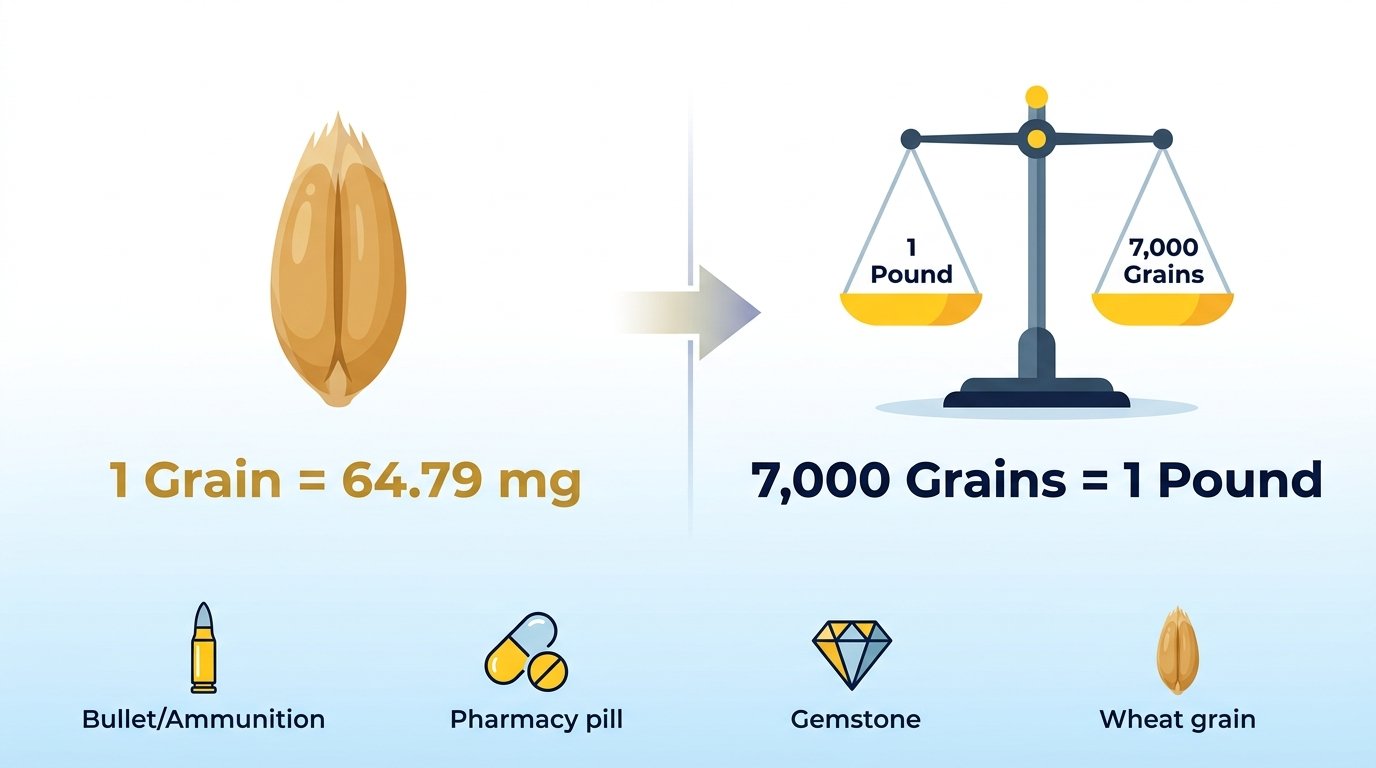
If you reload ammunition, work in pharmacy, or deal with precious metals, you have almost certainly come across the grain as a unit of weight. It is one of the oldest weight units still in active use, and understanding exactly how many grains in a pound there are is the starting point for dozens of practical calculations. This guide gives you the direct answer, explains where the grain comes from, covers conversions to grams, ounces, and milligrams, and walks through real examples from reloading, medicine, and gemology.
Formula (grains to pounds): lb = grains ÷ 7,000
Formula (pounds to grains): grains = lb × 7,000
1 grain = 64.79891 mg | 0.0648 g | 0.002286 oz
🔑 Key Takeaways
- 1 lb = 7,000 grains (exact, by definition)
- 1 oz = 437.5 grains (avoirdupois ounce)
- 1 troy oz = 480 grains (used for precious metals)
- 1 troy lb = 5,760 grains (12 troy ounces)
- 1 grain = 64.79891 mg exactly
- The grain is the same unit across avoirdupois, troy, and apothecary systems
- Used daily in ammunition reloading, pharmacy dosing, and gemstone weighing
📋 Table of Contents
- What Is a Grain? History and Definition
- How Many Grains Are in a Pound?
- Grain Conversion Formulas
- Free Grains to Pounds Calculator
- Worked Examples
- Grains to Pounds Reference Table
- Grains to Grams and Milligrams
- Grain in the Troy and Apothecary Systems
- Practical Uses of the Grain Unit
- Frequently Asked Questions
What Is a Grain? History and Definition
The grain (abbreviation: gr) is the smallest unit of weight in the imperial and US customary systems. It gets its name from the idea that it was originally based on the weight of a single dried grain of wheat or barley from the middle of the ear. While that origin story is largely historical, the grain is now a precisely defined unit: 1 grain = 64.79891 milligrams, exactly.
This definition was standardised under the International Yard and Pound Agreement of 1959, which fixed the value of the international pound and, by extension, the grain. The grain predates both the metric and the modern imperial systems, appearing in medieval English law and remaining in continuous use ever since.
What makes the grain unusual is that it is shared across three otherwise different weight systems: the avoirdupois system (used for everyday goods), the troy system (used for precious metals), and the apothecary system (historically used in pharmacy). One grain means the same thing in all three: 64.79891 mg. Only the ounce and pound differ between systems.
How Many Grains Are in a Pound?
The answer depends on which pound you mean, and this is where most confusion arises.
Avoirdupois Pound (the everyday pound)
The standard pound used in everyday life in the US and UK is the avoirdupois pound. It contains exactly 7,000 grains. This is a fixed, defined relationship with no rounding. If someone asks how many grains in a pound without any other context, the answer is always 7,000.
- 1 avoirdupois lb = 7,000 grains
- 1 avoirdupois oz = 437.5 grains (7,000 ÷ 16)
Troy Pound (used for precious metals)
The troy pound is used for gold, silver, platinum, and other precious metals. It is smaller than the avoirdupois pound and contains 5,760 grains. This comes from the troy pound being divided into 12 troy ounces, with each troy ounce equalling 480 grains (12 × 480 = 5,760).
- 1 troy lb = 5,760 grains
- 1 troy oz = 480 grains
Grain Conversion Formulas
All grain conversions flow from two anchor facts: 1 lb = 7,000 gr and 1 gr = 64.79891 mg.
Pounds to Grains: grains = lb × 7,000
Grains to Ounces (avoirdupois): oz = grains ÷ 437.5
Ounces to Grains: grains = oz × 437.5
Grains to Grams: g = grains × 0.06479891
Grams to Grains: grains = g × 15.4324
Grains to Milligrams: mg = grains × 64.79891
⚡ Free Grains to Pounds Calculator
Enter any value and choose your conversion direction. The calculator uses the exact 7,000-grain-per-pound definition:
Grain Weight Converter
Enter a value and select what you want to convert:
Worked Examples
Let's work through several practical calculations using the formulas above.
Example 1: How many grains are in 0.5 lb?
0.5 × 7,000 = 3,500 grains. Half a pound of gunpowder or propellant contains exactly 3,500 grains, which is why powder cans are often marked in both units.
Example 2: How many grains are in 2 pounds?
2 × 7,000 = 14,000 grains. A two-pound container of reloading powder holds 14,000 grains of propellant.
Example 3: Convert 500 grains to pounds
500 ÷ 7,000 = 0.07143 lb (approximately). In ounces: 500 ÷ 437.5 = 1.143 oz. This is close to the weight of a large-calibre bullet.
Example 4: Convert 150 grains to grams
150 × 0.06479891 = 9.72 grams. A 150-grain rifle bullet weighs just under 10 grams. This gives you a feel for how lightweight individual grains really are.
Example 5: Convert 1 grain to milligrams
1 × 64.79891 = 64.79891 mg. In older apothecary and pharmacy references, a 1-grain aspirin tablet was the standard dose — roughly 65 mg, which is the exact metric equivalent.
Grains to Pounds Conversion Table
This quick-reference table covers the most commonly needed grain-to-pound values. All figures use the exact avoirdupois definition of 7,000 grains per pound.
| Grains (gr) | Pounds (lb) | Ounces (oz) | Grams (g) |
|---|---|---|---|
| 1 gr | 0.000143 lb | 0.002286 oz | 0.0648 g |
| 50 gr | 0.007143 lb | 0.11429 oz | 3.240 g |
| 100 gr | 0.014286 lb | 0.22857 oz | 6.480 g |
| 150 gr | 0.021429 lb | 0.34286 oz | 9.720 g |
| 200 gr | 0.028571 lb | 0.45714 oz | 12.960 g |
| 437.5 gr | 0.0625 lb | 1.000 oz | 28.350 g |
| 500 gr | 0.071429 lb | 1.14286 oz | 32.399 g |
| 1,000 gr | 0.142857 lb | 2.28571 oz | 64.799 g |
| 1,750 gr | 0.250 lb | 4.000 oz | 113.398 g |
| 3,500 gr | 0.500 lb | 8.000 oz | 226.796 g |
| 5,760 gr | 0.822857 lb | 13.1657 oz | 373.242 g |
| 7,000 gr | 1.000 lb | 16.000 oz | 453.592 g |
| 14,000 gr | 2.000 lb | 32.000 oz | 907.185 g |
Grains to Grams and Milligrams
Because the grain predates the metric system, converting between grains and metric units is a common need in science, pharmacy, and manufacturing. The exact conversion is:
- 1 grain = 64.79891 milligrams (exact, internationally defined)
- 1 grain = 0.06479891 grams
- 1 gram = 15.4324 grains
- 1 kilogram = 15,432.4 grains
This metric equivalent matters because the 64.79891 mg value is not a measured approximation. It was fixed when the international yard and pound were redefined in 1959 by Australia, Canada, New Zealand, South Africa, the UK, and the US, creating a single internationally agreed value for the grain.
For quick mental maths, remembering that 1 grain ≈ 65 mg and 1 gram ≈ 15.4 grains will get you close enough for most everyday purposes. For precision reloading or pharmaceutical work, always use the full decimal values. For more unit comparison context, see our guide on weight vs. mass and why the distinction matters.
Grain in the Troy and Apothecary Systems
The grain bridges three historical weight systems because it was standardised before those systems diverged. Here is how the grain fits into each:
Avoirdupois System
Used for everyday goods, groceries, and postal weights. The avoirdupois pound = 16 ounces = 7,000 grains = 453.592 grams.
Troy System
Used for gold, silver, platinum, and gemstones. The troy pound = 12 troy ounces = 5,760 grains = 373.242 grams. A troy ounce (31.1035 g) is heavier than an avoirdupois ounce (28.3495 g) because a troy pound contains fewer ounces.
Apothecary System
Historically used by pharmacists and physicians. The apothecary pound = 12 apothecary ounces = 5,760 grains, identical to the troy pound. The apothecary system is now largely replaced by metric units in medicine, but the grain survives in some clinical contexts, particularly in the United States where some drug doses are still expressed in grains. Our article on engineering and scientific unit conversions covers more legacy unit systems still in active use.
Practical Uses of the Grain Unit
Knowing how many grains in a pound is directly useful in several industries. Here are the most common real-world contexts where the grain is the standard unit:
Ammunition and Reloading
The grain is the universal unit for bullet weight and powder charge in the ammunition industry. When you see a box of 9mm ammunition rated at "115 gr," that is the weight of the projectile in grains. Common weights range from 55 gr for light .223 Remington varmint loads to 750 gr for extreme long-range .50 BMG bullets.
Reloaders measure powder charges in tenths of a grain using a powder scale, and they buy propellant by the pound. Knowing that one pound of powder equals 7,000 grains tells a reloader exactly how many charges they can get from a container: a 45-grain charge per round from a one-pound can = 7,000 ÷ 45 = approximately 155 rounds.
Pharmacy and Medicine
Before the widespread adoption of metric units, drug doses in the US and UK were routinely prescribed in grains. The original aspirin tablet was a 5-grain dose (about 325 mg). Some medications still list grain equivalents on US labels: thyroid medications (such as desiccated thyroid extract) are commonly dosed in grains (1 grain = 60 mg by convention in that specific context, though the precise metric equivalent of a grain is 64.79891 mg).
Precious Metals and Gemstones
While the troy ounce is the dominant precious metals unit today, the grain appears in historical gold assay records and is still used by some pearl traders. Natural and cultured pearls are sometimes weighed in grains, where one pearl grain = one quarter of a carat = 50 mg (note: the pearl grain is a specific trade convention, not the standard 64.79891 mg grain).
Arrow Spine and Archery
Bowhunters use grains to specify arrow weight. Total arrow weight, point weight, and nock weight are all measured in grains. A typical hunting arrow might weigh 400 to 500 grains total, and a broadhead point might add 100 to 125 grains. Knowing that 437.5 grains equal one ounce helps archers compare weights from different sources. For more on unit conversions used in outdoor sports, see our guide to metric vs. imperial measurement systems.
Water Softening
Water hardness in the United States is commonly measured in grains per gallon (GPG). One grain per gallon means one grain (64.79891 mg) of calcium carbonate dissolved per US gallon of water. A water softener capacity is rated in grains: a 32,000-grain softener can remove 32,000 grains of hardness minerals before it needs to regenerate. To put that in perspective: 32,000 grains = 32,000 ÷ 7,000 = approximately 4.57 pounds of dissolved minerals.
Summary
There are exactly 7,000 grains in one avoirdupois pound and 5,760 grains in one troy pound. The grain itself is defined as 64.79891 milligrams, a value fixed internationally in 1959 and unchanged since. Whether you are loading ammunition, checking a historical pharmaceutical dose, pricing precious metals, or sizing a water softener, the grain is a precise and well-defined unit that connects directly to the pound through these exact ratios.
Use the calculator above for any specific conversion, or refer to the reference table for common weights at a glance. For related weight conversions, our weight converter tool handles grams, kilograms, pounds, ounces, and more in one place.
Frequently Asked Questions (FAQs)
How many grains are in a pound?
There are exactly 7,000 grains in one avoirdupois pound. This is a fixed, defined value with no rounding: 1 lb = 7,000 gr, by definition under the international standard.
How many grains are in an ounce?
There are exactly 437.5 grains in one avoirdupois ounce. Calculation: 7,000 grains per pound ÷ 16 ounces per pound = 437.5 grains per ounce.
What is one grain in grams?
One grain equals exactly 64.79891 milligrams, or approximately 0.0648 grams. This is the internationally standardised value agreed upon in 1959.
How many grains are in a troy pound?
A troy pound contains 5,760 grains. A troy pound = 12 troy ounces, and 1 troy ounce = 480 grains. So 12 × 480 = 5,760.
What does grain mean in bullet weight?
In ammunition, grain (gr) refers to the weight of the projectile or powder charge. A heavier grain bullet (e.g. 180 gr) is slower but retains energy at long range; a lighter grain bullet (e.g. 55 gr) is faster with a flatter trajectory. Common handgun bullet weights range from 90 to 230 grains.
How do I convert grains to pounds?
Divide the grain value by 7,000. Formula: lb = grains ÷ 7,000. Example: 3,500 grains ÷ 7,000 = 0.5 lb.
How many grains are in a pound of gunpowder?
Exactly 7,000 grains. Gunpowder and propellant are sold by the pound and measured by the grain. A one-pound container of powder holds 7,000 grains, regardless of the powder type.
Is the grain the same in the avoirdupois and troy systems?
Yes. The grain is identical across all systems: 1 grain = 64.79891 mg in the avoirdupois, troy, and apothecary systems. Only the number of grains per ounce or pound differs between these systems.
Weight Converter (kg, lbs, g, oz) • Weight vs. Mass: Understanding the Difference • Engineering Unit Conversions Guide • Metric vs. Imperial: Complete Guide