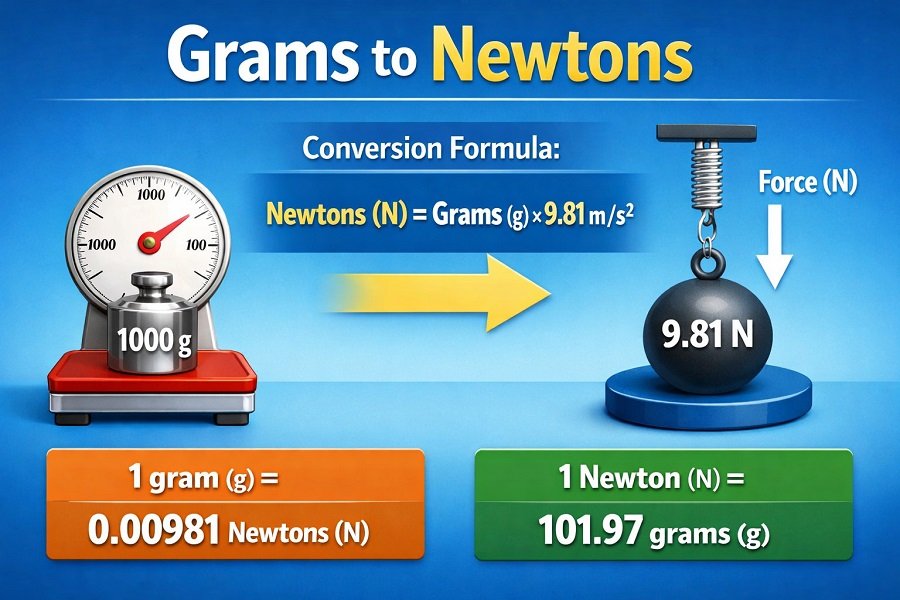
Whether you are a physics student, an engineer, or someone checking a product specification, knowing how to convert grams to newtons is a fundamental skill. The gram is a unit of mass, and the newton is the SI derived unit of force. Converting between them requires Earth's standard gravitational acceleration. This complete guide explains the gram force to newton formula, works through real examples, and provides a free online calculator so you can get an accurate value instantly.
Formula: N = grams × 0.00980665
Example: 100 grams = 100 × 0.00980665 = 0.980665 N
🔑 Key Takeaways
- 1 gram = 0.00980665 newtons under standard Earth gravity
- Formula: N = grams × 0.00980665
- The newton (symbol N) is the SI derived unit of force
- Gram force (gf) is the gravitational pull on a 1-gram mass under standard Earth gravity
- 1 N = 101.972 gf (inverse conversion)
- Standard Earth gravity used in all conversions: 9.80665 m/s²
- Grams measure mass; newtons measure force — they are not interchangeable
📋 Table of Contents
- What Is a Newton? The SI Derived Unit of Force
- What Is Gram Force (gf) and Its Symbol?
- Grams to Newtons Conversion Formula
- Free Online Grams to Newtons Calculator
- Worked Examples: Convert Gram Force to Newton
- Grams to Newtons Conversion Table
- Mass vs. Force: Understanding the Difference
- Role of Earth Gravity in the Conversion
- Where Is Gram Force (gf) Used in Practice?
- Newton Conversion Reference Table
- Reverse Conversion: Newtons to Grams
- Frequently Asked Questions
What Is a Newton? The SI Derived Unit of Force
The newton (symbol: N) is the SI derived unit of force in the International System of Units (SI). It is defined as the amount of force required to accelerate a mass of one kilogram at a rate of one metre per second squared. Named after Sir Isaac Newton in recognition of his work on classical mechanics, the newton replaced older non-SI units such as the dyne and the kilogram-force in modern scientific and engineering contexts.
The newton symbol N is always written as a capital letter. Its dimensional formula is: 1 N = 1 kg·m/s². This means that one newton is the force needed to give a one-kilogram object an acceleration of one metre per second squared. In everyday terms, holding up a small apple in your hand requires approximately one newton of force.
As a derived unit, the newton is expressed entirely in terms of the three SI base units: kilogram (mass), metre (length), and second (time). This relationship is what makes the newton consistent across all branches of physics and engineering.
What Is Gram Force (gf) and Its Symbol?
A gram (g) is a metric unit of mass equal to one thousandth of a kilogram. On its own, a gram tells you nothing about force. However, when a 1-gram mass is placed in a gravitational field, gravity pulls it downward with a specific amount of force. That force is called gram force, and its symbol is gf.
Gram force is a gravitational metric unit of force. It is not part of the SI system, but it remains in common use in many industries, particularly where small forces need to be expressed in units that correspond directly to familiar mass values. The value of 1 gf is equal to the force exerted by gravity on a 1-gram mass at standard Earth gravity:
- 1 gf = 0.00980665 N
- 1 N = approximately 101.972 gf
- Standard Earth gravity used: g₀ = 9.80665 m/s²
The gram force unit is often confused with the gram itself, but the distinction is crucial: a gram is a unit of mass, while gram force is a unit of force. This is exactly the same conceptual difference that exists between kilogram and kilogram-force, or between pound-mass and pound-force.
Grams to Newtons Conversion Formula
The conversion is based on Newton's second law of motion: Force = Mass × Acceleration. When you want to find the gravitational force (weight) acting on a mass, you multiply that mass by the acceleration due to gravity. Using standard Earth gravity:
Force (N) = Mass (grams) × 0.00980665
Alternative Formula (via kilograms):
Force (N) = (grams ÷ 1000) × 9.80665
Both formulas are mathematically equal and give the same result. The factor 0.00980665 is simply 9.80665 divided by 1000.
The constant 0.00980665 comes directly from the standard gravitational acceleration 9.80665 m/s² divided by 1000 (to convert the gram to a kilogram). This value is fixed and internationally agreed upon by the General Conference on Weights and Measures (CGPM), so it applies universally regardless of where on Earth you are performing the calculation.
⚡ Free Online Grams to Newtons Calculator
Enter your mass value in grams below to instantly convert gram force to newtons. The calculator applies the exact CGPM-standard conversion factor:
Grams to Newtons Converter
Worked Examples: Convert Gram Force to Newton
The following examples show how to apply the formula step by step. In each case the gram force value is converted to its equivalent in newtons using the standard Earth gravity constant.
Example 1: Convert 1 gram to newtons
1 gram × 0.00980665 = 0.00980665 N. So 1 gf is equal to 0.00981 N rounded to five significant figures. This is the fundamental conversion unit: one gram-force equals one newton divided by approximately 101.972.
Example 2: Convert 10 grams to newtons
10 × 0.00980665 = 0.0980665 N. Ten grams of mass exerts just under one tenth of a newton of gravitational force under standard Earth conditions.
Example 3: Convert 100 grams to newtons
100 × 0.00980665 = 0.980665 N. A 100-gram mass exerts approximately 0.98 newtons of force, which is just under the force of holding up a small apple.
Example 4: Convert 500 grams to newtons
500 × 0.00980665 = 4.903325 N. Half a kilogram of mass produces approximately 4.9 newtons of gravitational force.
Example 5: Convert 1 kilogram (1000 grams) to newtons
1000 × 0.00980665 = 9.80665 N. This is exactly the weight of a 1-kilogram object under standard Earth gravity, which is why the kilogram-force (kgf) is defined as 9.80665 N.
Grams to Newtons Conversion Table
Use this quick-reference table to convert gram force values to newtons without calculation. All values use the standard Earth gravity constant of 9.80665 m/s².
| Grams (g / gf) | Newtons (N) | Equivalent (kgf) |
|---|---|---|
| 1 g | 0.009807 N | 0.001 kgf |
| 5 g | 0.049033 N | 0.005 kgf |
| 10 g | 0.098067 N | 0.01 kgf |
| 25 g | 0.245166 N | 0.025 kgf |
| 50 g | 0.490333 N | 0.05 kgf |
| 100 g | 0.980665 N | 0.1 kgf |
| 200 g | 1.961330 N | 0.2 kgf |
| 250 g | 2.451660 N | 0.25 kgf |
| 500 g | 4.903325 N | 0.5 kgf |
| 750 g | 7.354988 N | 0.75 kgf |
| 1000 g (1 kg) | 9.806650 N | 1 kgf |
| 2000 g (2 kg) | 19.613300 N | 2 kgf |
Mass vs. Force: Understanding the Difference
One of the most common mistakes in unit conversion is treating mass and force as the same thing. They are related, but they are fundamentally different physical quantities with different units and different meanings.
Mass is the amount of matter contained in an object. It is measured in grams or kilograms and does not change regardless of where the object is located. A 100-gram object on Earth has the same mass on the Moon and in outer space.
Force, on the other hand, is what results when a mass is subjected to an acceleration. Weight is a specific type of force: the gravitational force acting on a mass. It is measured in newtons (the SI derived unit of force) and changes depending on the gravitational environment. A 100-gram object weighs 0.98 N on Earth, but would weigh only about 0.16 N on the Moon because the Moon's gravitational acceleration is approximately 1.62 m/s², much lower than Earth's 9.80665 m/s².
Role of Earth Gravity in the Conversion
The conversion factor 0.00980665 is not arbitrary: it is derived directly from the standard gravitational acceleration of Earth. The General Conference on Weights and Measures (CGPM) adopted the value g₀ = 9.80665 m/s² as the internationally recognised standard acceleration of gravity at sea level and 45 degrees latitude. This value is used consistently in all gram force to newton conversions.
In practice, Earth's actual gravitational acceleration varies slightly from place to place. At the equator it is approximately 9.780 m/s², and at the poles it is approximately 9.832 m/s². However, for all unit conversion purposes, the standard value of 9.80665 m/s² is always used, ensuring consistent and reproducible results regardless of geographic location.
This is why the gram-force (gf) is defined specifically with respect to standard Earth gravity. It represents the gravitational force that Earth would exert on a mass of 1 gram at standard conditions, and this is the only value used when you convert grams to newtons in any calculator or reference table.
Where Is Gram Force (gf) Used in Practice?
Although gram force (gf) is not an official SI unit, it remains widely used across several industries and applications where small forces need to be expressed in a way that is intuitive for practitioners accustomed to mass measurements:
- Mechanical keyboard springs: Keyboard switch actuation force is rated in grams-force (e.g., Cherry MX Red: 45 gf, Cherry MX Blue: 60 gf). Knowing how to convert gram force to newton helps engineers compare specifications across standards.
- Fishing line strength: Fishing lines are often rated in grams-force, indicating the breaking force of the line under standard gravity.
- Textile and thread testing: Thread tensile strength in industrial weaving and embroidery is routinely measured in grams-force per unit cross-section.
- Medical and laboratory scales: Analytical balances and force gauges in laboratories often report values in grams-force, which must then be converted to newtons for scientific reporting.
- Robotics and haptics: Tactile sensors used in robotic fingertips and medical devices such as surgical robots measure contact force in grams-force for fine resolution.
- Spring scale calibration: Household and postal spring scales are calibrated in grams or kilograms, representing gram-force or kilogram-force respectively.
In all these contexts, being able to convert gram force to the SI derived unit (newton) is critical for interoperability with international standards and for performing calculations using Newton's laws of motion.
Newton Conversion Reference Table
The newton can be readily converted to and from other common units of force. This table shows the equal values in newtons for each unit, along with the unit symbol:
| Unit of Force | Symbol | Equal to (N) |
|---|---|---|
| Gram force | gf | 0.00980665 N |
| Kilogram force | kgf | 9.80665 N |
| Pound force | lbf | 4.44822 N |
| Ounce force | ozf | 0.27801 N |
| Dyne | dyn | 0.00001 N |
| Millinewton | mN | 0.001 N |
| Kilonewton | kN | 1000 N |
Reverse Conversion: Newtons to Grams
Occasionally you may need to go in the opposite direction and convert a force value in newtons back to gram force units. The reverse formula is straightforward:
Gram Force (gf) = Newtons (N) ÷ 0.00980665
or equivalently:
Gram Force (gf) = Newtons (N) × 101.9716
Examples:
1 N = 101.972 gf
5 N = 509.858 gf
9.80665 N = 1000 gf (equal to 1 kilogram-force)
This reverse conversion is especially useful when reading engineering specifications listed in newtons and needing to relate them to masses in grams. For instance, a spring rated at 2 N can support approximately 203.9 grams under standard Earth gravity before reaching its rated load.
Summary: Key Facts About Grams to Newtons Conversion
Converting grams to newtons is a straightforward multiplication once you understand the distinction between mass and force. The gram force (gf) unit bridges the two by representing the gravitational pull on a known mass under standard Earth conditions. The conversion factor 0.00980665 is derived from the internationally standardised value of Earth's gravitational acceleration (9.80665 m/s²).
The newton (symbol N) is the correct SI derived unit for expressing force in any scientific or engineering context. It is dimensionally consistent with the SI base units and allows force values to be used directly in equations such as F = ma, W = Fd, and P = F/A without any additional conversion. Whether you are designing a mechanical system, interpreting a sensor reading, or checking product specifications, the ability to accurately convert gram force to newton ensures your calculations meet international standards.
Use the free online newton conversion calculator at the top of this article to get instant, accurate results for any value in grams. For further related conversions, explore our weight converter or read our guide on Weight vs. Mass.
Frequently Asked Questions (FAQs)
How do you convert grams to newtons?
Multiply the mass in grams by 0.00980665. Formula: N = g × 0.00980665. Example: 100 grams = 100 × 0.00980665 = 0.980665 N.
What is 1 gram in newtons?
1 gram = 0.00980665 newtons (approximately 0.00981 N) under standard Earth gravity (9.80665 m/s²). This is also expressed as 1 gf = 0.00980665 N.
What is gram force (gf)?
Gram force (gf) is the gravitational force exerted on a 1-gram mass under standard Earth gravity. It equals 0.00980665 N. It is a non-SI unit of force and is symbolised as gf.
What is the newton symbol?
The newton symbol is N (capital N). It is the SI derived unit of force: 1 N = 1 kg·m/s². The capital letter is used because the unit is named after a person (Sir Isaac Newton).
How many newtons is 1 kilogram?
1 kilogram = 9.80665 newtons under standard Earth gravity. Since 1 kg = 1000 g and 1 g = 0.00980665 N, multiplying gives 1000 × 0.00980665 = 9.80665 N.
How many grams equal 1 newton?
1 newton is equal to approximately 101.972 grams-force. Calculation: 1 ÷ 0.00980665 = 101.9716 gf.
Why do we convert grams to newtons?
Grams measure mass; newtons measure force. All physics and engineering force calculations use newtons as the standard SI unit. Newton's second law (F = ma) requires force in newtons, not grams.
What is the difference between mass and force?
Mass (g, kg) is the amount of matter in an object and does not change with location. Force (N) is the interaction that changes an object's motion, including gravitational pull (weight). Weight = mass × gravitational acceleration.
Weight Converter (kg, lbs, g, oz) • Weight vs. Mass: Understanding the Difference • Engineering Unit Conversions: Force, Pressure, Power