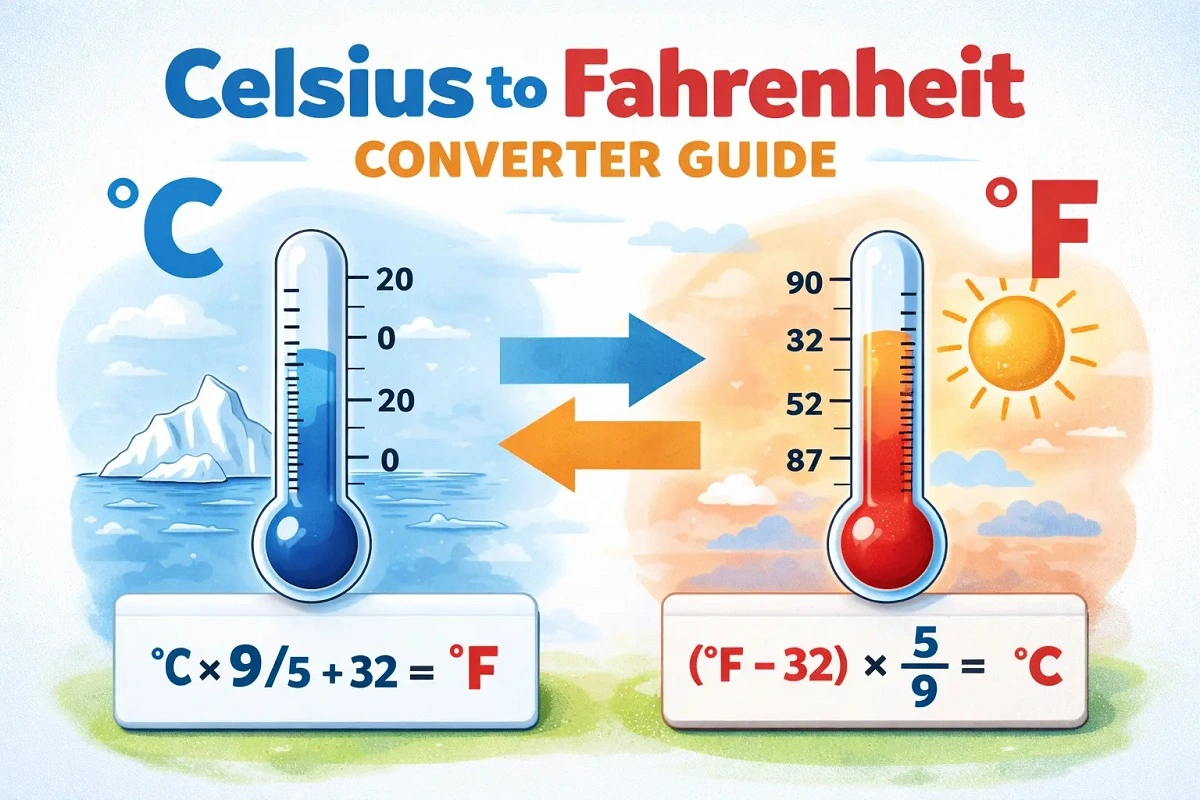
Understanding Temperature Scales
Temperature measurement is fundamental to science, cooking, weather forecasting, and daily life. Different parts of the world use different temperature scales, primarily Celsius (°C) and Fahrenheit (°F). Understanding how to convert between these scales is essential for international communication, travel, and accessing information from diverse sources.
While most of the world uses Celsius, the United States, some Caribbean nations, and a few territories still use Fahrenheit. This guide will teach you everything you need to know about converting between these two temperature scales accurately and efficiently.
The Celsius Scale (°C)
The Celsius scale, also known as centigrade, is the standard temperature scale used in most countries worldwide and in all scientific work. Swedish astronomer Anders Celsius developed it in 1742, creating a decimal-based system that's intuitive and logical.
Key Celsius Reference Points
- Freezing point of water: 0°C
- Boiling point of water: 100°C (at standard atmospheric pressure)
- Absolute zero: -273.15°C
- Human body temperature: ~37°C
- Room temperature: ~20-22°C
- Hot summer day: 30-35°C
- Cold winter day: -10 to 0°C
The Celsius scale is based on water's phase changes—0 for freezing and 100 for boiling—making it decimal, intuitive, and perfect for scientific calculations.
The Fahrenheit Scale (°F)
The Fahrenheit scale is primarily used in the United States, its territories, and a few Caribbean nations. German physicist Daniel Gabriel Fahrenheit proposed it in 1724, creating a scale where common temperatures fall between 0 and 100.
Key Fahrenheit Reference Points
- Freezing point of water: 32°F
- Boiling point of water: 212°F
- Absolute zero: -459.67°F
- Human body temperature: ~98.6°F
- Room temperature: ~68-72°F
- Hot summer day: 86-95°F
- Cold winter day: 14-32°F
Conversion Formulas: The Mathematics Behind Temperature
Celsius to Fahrenheit Formula
The formula to convert Celsius to Fahrenheit is:
Or alternatively: °F = (°C × 1.8) + 32
Step-by-Step Conversion Example
Let's convert 25°C to Fahrenheit:
- Start with 25°C
- Multiply by 9/5 (or 1.8): 25 × 1.8 = 45
- Add 32: 45 + 32 = 77
- Result: 25°C = 77°F
Fahrenheit to Celsius Formula
To convert Fahrenheit to Celsius:
Or alternatively: °C = (°F - 32) ÷ 1.8
Step-by-Step Conversion Example
Let's convert 68°F to Celsius:
- Start with 68°F
- Subtract 32: 68 - 32 = 36
- Multiply by 5/9 (or divide by 1.8): 36 ÷ 1.8 = 20
- Result: 68°F = 20°C
Quick Mental Math Conversion Methods
Quick Celsius to Fahrenheit Estimation
For a rapid estimate without a calculator:
- Method: Multiply by 2 and add 30
- Example: 18°C → (18 × 2) + 30 = 66°F (actual: 64.4°F)
- Accuracy: Within 2-3 degrees for most common temperatures
Quick Fahrenheit to Celsius Estimation
- Method: Subtract 30 and divide by 2
- Example: 80°F → (80 - 30) ÷ 2 = 25°C (actual: 26.7°C)
- Accuracy: Within 2 degrees for typical weather temperatures
Common Temperature Conversions
Weather Temperatures
- -40°C = -40°F (the only matching point!)
- -20°C = -4°F (very cold winter)
- -10°C = 14°F (cold winter day)
- 0°C = 32°F (water freezes)
- 10°C = 50°F (cool day)
- 15°C = 59°F (mild day)
- 20°C = 68°F (comfortable room temperature)
- 25°C = 77°F (warm pleasant day)
- 30°C = 86°F (hot day)
- 37°C = 98.6°F (human body temperature)
- 40°C = 104°F (very hot day)
Cooking Temperatures
- 100°C = 212°F (water boils)
- 120°C = 250°F (slow roasting)
- 150°C = 300°F (moderate oven)
- 175°C = 350°F (standard baking)
- 200°C = 400°F (hot oven)
- 220°C = 425°F (very hot oven)
- 230°C = 450°F (pizza oven)
Practical Applications of Temperature Conversion
International Travel
When traveling from the US to Europe, weather forecasts will be in Celsius. Knowing that 25°C is a pleasant 77°F helps you pack appropriately. Conversely, Europeans visiting the US need to understand that 90°F is a hot 32°C. Use our free temperature converter before your trip!
Cooking and Recipes
American recipes specify oven temperatures in Fahrenheit, while European recipes use Celsius. Converting accurately ensures your dishes cook properly—the difference between a perfectly baked cake and a culinary disaster. Learn more with our kitchen measurement conversions guide.
Medical and Health
While US doctors use Fahrenheit for body temperature (98.6°F normal), international medical literature uses Celsius (37°C normal). A fever is 38°C or 100.4°F. Understanding both systems is crucial for medical professionals and travelers.
Science and Research
All scientific publications use Celsius or Kelvin. Understanding these scales is essential for reading research papers, understanding experimental procedures, and communicating findings globally. For scientific unit conversions, check our engineering conversions guide.
Pro Tips for Accurate Temperature Conversion
When converting F to C, you MUST subtract 32 BEFORE multiplying by 5/9. Many people make the mistake of doing operations in the wrong order. Remember: Parentheses first!
While mental math is great for estimates, use our temperature converter tool for precise measurements in cooking, medical, or scientific applications.
A change of 1°C equals a change of 1.8°F. However, absolute temperatures don't convert the same way as temperature differences. For example, 0°C + 10°C = 10°C, but 32°F + 18°F ≠ 50°F in the conversion sense.
Maintain precision through your calculations and round only the final answer. Rounding too early introduces cumulative errors that can significantly affect your result.
Common Temperature Conversion Mistakes to Avoid
- Forgetting to add/subtract 32: Simply multiplying by 1.8 doesn't work—you must account for the offset between the scales
- Using wrong order of operations: For F to C, subtract 32 BEFORE dividing
- Confusing temperature intervals with absolute temperatures: The conversion factor differs
- Rounding too early: Keep decimals until the final calculation
- Using approximations for precision work: Mental math is fine for weather, but use exact formulas for cooking or science
Why Different Temperature Scales Exist
Fahrenheit based his scale on three reference points: an ice-salt mixture (0°F), water's freezing point (32°F), and human body temperature (originally 96°F, later adjusted to 98.6°F). This created a scale where common temperatures fell between 0 and 100.
Celsius created a more logical scale based solely on water's phase changes—0 for freezing and 100 for boiling—making it decimal, intuitive, and perfect for scientific work.
Today, approximately 95% of the world's population uses Celsius, while Fahrenheit remains primarily in the United States and a few territories.
Using Temperature Conversion Tools
While understanding the formulas is valuable, modern tools make instant conversions effortless:
- Online Converters: Use our free temperature converter for instant, accurate results
- Mobile Apps: Most weather apps allow toggling between °C and °F
- Smart Assistants: Ask Siri, Alexa, or Google Assistant for quick conversions
- Scientific Calculators: Many have built-in temperature conversion functions
Conclusion
Understanding temperature scale conversions is essential in our globalized world. Whether you're checking weather forecasts abroad, following international recipes, reading scientific literature, or communicating across cultures, knowing how to convert between Celsius and Fahrenheit is invaluable.
The key formulas are straightforward: multiply Celsius by 1.8 and add 32 for Fahrenheit, or subtract 32 from Fahrenheit and divide by 1.8 for Celsius. With practice, common conversions become second nature.
For quick and accurate conversions, bookmark our temperature converter tool and explore more unit conversion tools for all your measurement needs.
• Metric vs Imperial Systems Guide
• Kitchen Measurement Conversions
• Engineering Unit Conversions
• Browse All Converters