Understanding Calories and Joules
Energy is measured in different units depending on the context and geographic location. The two most common units for measuring energy—especially in nutrition and physics—are calories and joules. Understanding how to convert between these units is essential for interpreting food labels, scientific calculations, and international nutritional information.
While the United States primarily uses calories for food energy, most other countries use kilojoules (kJ). Similarly, in physics and chemistry, the joule is the standard SI (International System of Units) unit of energy, making conversion knowledge crucial for students, scientists, fitness enthusiasts, and anyone reading international food labels.
What is a Calorie?
The term "calorie" is used in two different ways, which can cause confusion:
Small Calorie (cal)
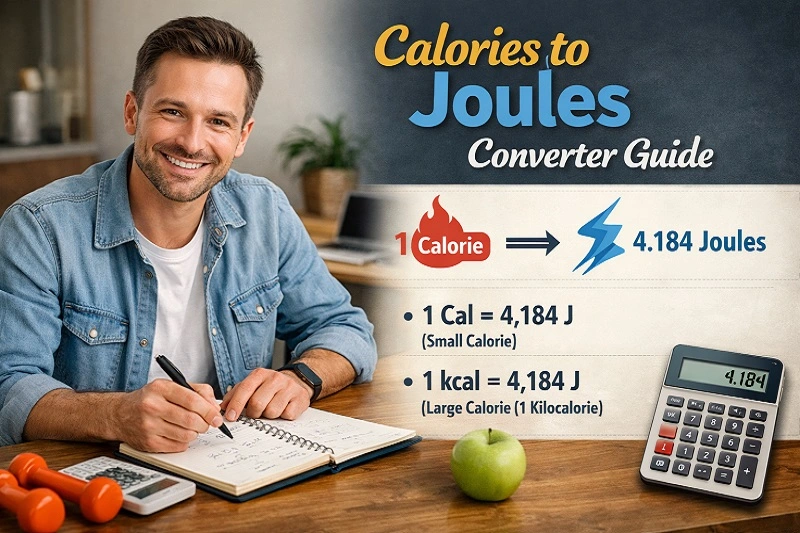
The small calorie, also known as the gram calorie, is defined as the amount of energy required to raise the temperature of 1 gram of water by 1 degree Celsius at standard atmospheric pressure. This unit is primarily used in chemistry and physics.
Food Calorie or Kilocalorie (Cal or kcal)
The food Calorie (note the capital C), also called kilocalorie, is the unit you see on food labels. One food Calorie equals 1,000 small calories. When you read that an apple contains 95 Calories, that's actually 95,000 small calories or 95 kilocalories.
Key Calorie Facts
- Symbol: cal (small calorie) or Cal/kcal (food Calorie)
- Origin: From Latin "calor" meaning heat
- Usage: Primarily in nutrition (food energy) and some chemistry applications
- Common in: United States, some parts of North America
What is a Joule?
The joule (J) is the SI unit of energy, named after English physicist James Prescott Joule. It's defined as the amount of energy transferred when a force of one newton is applied over a distance of one meter. In terms of electrical energy, it's the energy dissipated as heat when an electric current of one ampere passes through a resistance of one ohm for one second.
Key Joule Facts
- Symbol: J
- Named after: James Prescott Joule (1818-1889)
- Usage: Universal scientific unit, food labels in most countries outside the US
- Common multiples: kilojoule (kJ) = 1,000 joules, megajoule (MJ) = 1,000,000 joules
For food energy, kilojoules (kJ) are most commonly used. When you see a food label in Europe, Australia, or many other countries, energy content is listed in kJ (and often alongside kcal for convenience).
Conversion Formulas: The Mathematics Behind Energy
Small Calorie to Joule Conversion
To convert small calories (cal) to joules (J):
Formula: Joules = Calories × 4.184
Food Calorie (Kilocalorie) to Kilojoule Conversion
To convert food Calories (kcal) to kilojoules (kJ):
Formula: Kilojoules = Calories × 4.184
Step-by-Step Conversion Example: Calories to Kilojoules
Let's convert 500 Calories (kcal) to kilojoules:
- Start with 500 Calories (kcal)
- Multiply by 4.184: 500 × 4.184 = 2,092
- Result: 500 Calories = 2,092 kJ
Joule to Calorie Conversion
To convert joules to small calories:
Formula: Calories = Joules × 0.239006
Kilojoule to Food Calorie Conversion
To convert kilojoules to food Calories (kcal):
Formula: Calories = Kilojoules × 0.239006
Or approximately: Calories ≈ Kilojoules ÷ 4.184
Step-by-Step Conversion Example: Kilojoules to Calories
Let's convert 1,000 kilojoules to Calories:
- Start with 1,000 kJ
- Multiply by 0.239006: 1,000 × 0.239006 = 239.006
- Result: 1,000 kJ ≈ 239 Calories
Quick Conversion Table
Calories to Kilojoules
| Calories (kcal) | Kilojoules (kJ) |
|---|---|
| 50 | 209.2 |
| 100 | 418.4 |
| 200 | 836.8 |
| 250 | 1,046 |
| 500 | 2,092 |
| 1,000 | 4,184 |
| 1,500 | 6,276 |
| 2,000 | 8,368 |
| 2,500 | 10,460 |
Kilojoules to Calories
| Kilojoules (kJ) | Calories (kcal) |
|---|---|
| 500 | 119.5 |
| 1,000 | 239 |
| 2,000 | 478 |
| 3,000 | 717 |
| 5,000 | 1,195 |
| 8,000 | 1,912 |
| 10,000 | 2,390 |
Practical Applications of Energy Conversion
Reading International Food Labels
When traveling or purchasing imported foods, you'll encounter different energy units. European food labels typically display both kJ and kcal, while Australian labels primarily use kJ. Being able to convert between these units helps you make informed dietary choices regardless of location. Use our free energy converter for instant conversions!
Fitness and Nutrition Planning
Many fitness apps and nutrition databases use different energy units depending on the region. If you're following a meal plan from an international source or using a fitness tracker set to a different region, understanding these conversions ensures accurate calorie tracking. Learn more with our kitchen measurement conversions guide.
Scientific and Educational Purposes
In chemistry and physics, energy calculations typically use joules as the standard SI unit. Students and researchers often need to convert between calories and joules when working with thermodynamics, calorimetry experiments, or chemical reactions. For more scientific conversions, check our engineering conversions guide.
Exercise and Energy Expenditure
Fitness equipment and exercise databases may display energy burned in either Calories or kilojoules. Understanding the conversion helps you accurately track your workout intensity and energy expenditure, regardless of which measurement system your equipment uses.
Food Energy and Nutrition
Daily Energy Requirements
Average daily energy requirements vary by age, gender, activity level, and other factors:
- Adult women: 1,800-2,400 Calories (7,536-10,048 kJ)
- Adult men: 2,200-3,000 Calories (9,205-12,552 kJ)
- Active athletes: 3,000-5,000+ Calories (12,552-20,920+ kJ)
- Children (varies by age): 1,200-2,200 Calories (5,021-9,205 kJ)
Energy Content of Macronutrients
- Carbohydrates: 4 Calories/gram (17 kJ/g)
- Protein: 4 Calories/gram (17 kJ/g)
- Fat: 9 Calories/gram (37 kJ/g)
- Alcohol: 7 Calories/gram (29 kJ/g)
Pro Tips for Accurate Energy Conversion
Always use 4.184 as the conversion factor for the most accurate results. Some sources round to 4.2, which can introduce errors in larger calculations.
Make sure you're using the right type of calorie—small calorie (cal) for scientific calculations or food Calorie (Cal/kcal) for nutritional purposes. Confusing the two can result in errors of 1,000-fold!
While mental math is useful for approximations, use our energy converter tool for precise measurements needed in scientific work, dietary planning, or professional applications.
For daily nutrition tracking, rounding to whole numbers is usually sufficient (e.g., 2,092 kJ can be 2,090 kJ). For scientific work, maintain at least 3 significant figures.
Common Conversion Mistakes to Avoid
- Confusing small calories with food Calories: Remember that food Calories are actually kilocalories—1,000 times larger than small calories
- Using the wrong conversion factor: Always use 4.184, not rough approximations like 4 or 4.2, for accurate results
- Forgetting units: Always specify whether you're working with cal, Cal, kcal, J, or kJ
- Mixing up the formulas: To convert TO joules, multiply by 4.184; to convert FROM joules, divide by 4.184 (or multiply by 0.239)
Why Different Energy Units Exist
The calorie was developed in the 19th century based on the thermal properties of water, making it ideal for early thermodynamics and nutrition science. The joule, named after James Prescott Joule, was later adopted as the SI unit of energy because it relates directly to mechanical work and electrical energy, making it more versatile for physics and engineering.
Today, the scientific community uses joules almost exclusively, while the food and nutrition industries—especially in the United States—continue using Calories due to historical precedent and consumer familiarity. Many countries have adopted a hybrid approach, displaying both units on food labels.
Using Energy Conversion Tools
Modern tools make energy conversions simple and accurate:
- Online Converters: Use our free energy converter for instant, precise results
- Nutrition Apps: Many apps allow switching between Calories and kilojoules in settings
- Fitness Trackers: Most modern devices display energy in your preferred unit
- Scientific Calculators: Built-in conversion functions for various energy units
Conclusion
Understanding the relationship between calories and joules is essential for anyone working with energy measurements—whether you're tracking nutrition, conducting scientific experiments, or simply reading international food labels. The key conversion factor of 4.184 (1 Calorie = 4.184 kJ) is straightforward once you understand the difference between small calories and food Calories.
Remember that food labels use kilocalories (Calories with a capital C), which convert directly to kilojoules using the same 4.184 factor. With practice, these conversions become second nature, making it easy to navigate both American and international nutritional information.
For quick and accurate conversions, bookmark our energy converter tool and explore more unit conversion tools for all your measurement needs.